

Apprentice Spotlight: Megan Hostetler’s Phase One Playbook, Read Every Word and Submit Step by Step
Key Takeaways
Who Is Megan Hostetler and Why Does Her Playbook Matter?
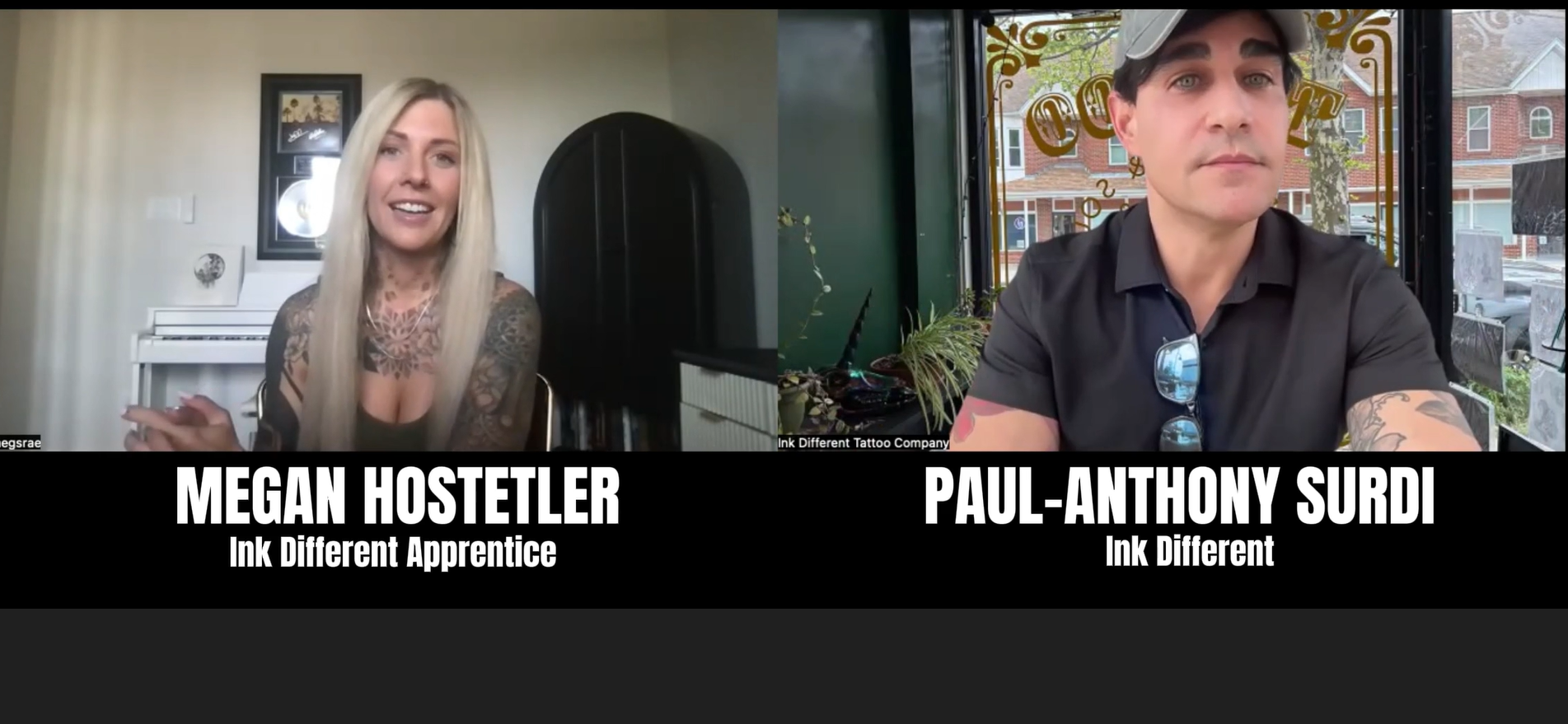
Megan Hostetler is an Ink Different apprentice in Dallas, Texas, and a mom of three kids, ages six, four, and one. She’s moving into Phase Two and will train with BillyJack Gunter at Artistic Encounters.
She’s completely self-taught as an artist, with no formal art background. Her route into tattooing was unconventional. Three or four years ago, while drinking at home with friends, she bought a rotary pen machine online and started tattooing them. “I would just find myself tattooing like four or five people in a night,” she says.
Those early days came with mistakes, including blowouts on hand tattoos and tattooing an elderly man who’d been drinking. She knew she needed a real foundation to do precise work and keep clients safe.
Her playbook matters because she moved through Phase One quickly without cutting corners. Her habits are simple enough for any apprentice to copy.
What Is Phase One of a Tattoo Apprenticeship?
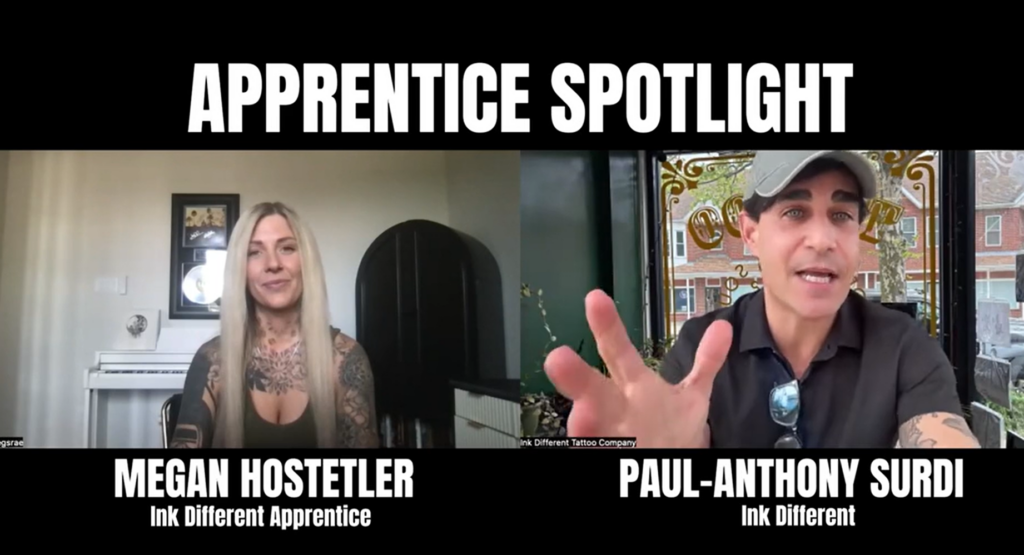
Phase One of Ink Different’s Traditional Tattoo Apprenticeship is art and design. It happens online, and it’s where apprentices learn to draw for tattooing.
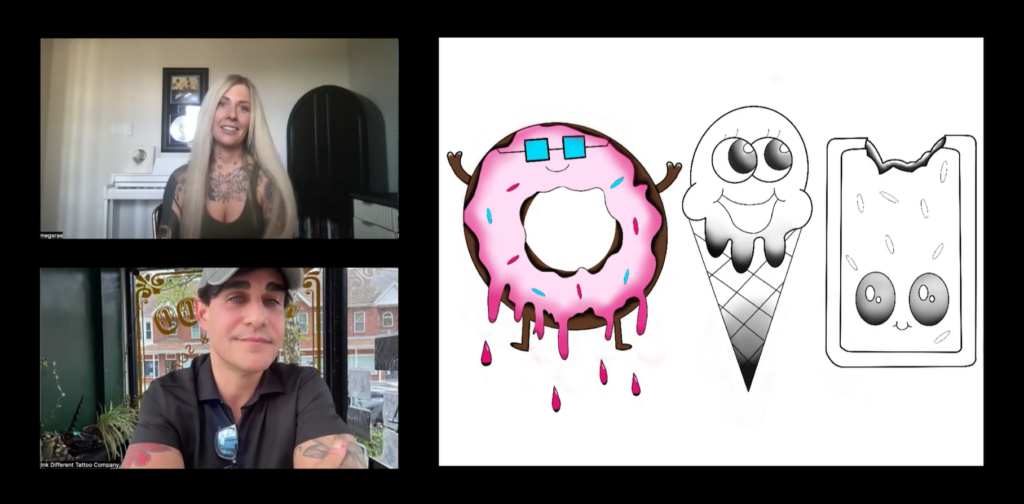
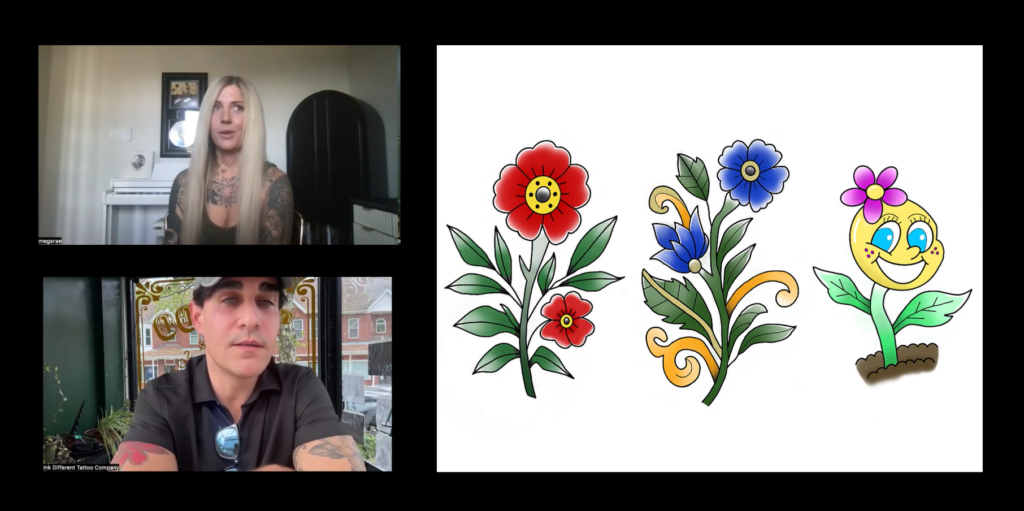
Megan’s Phase One covered four styles: American traditional, neo-traditional, new school, and Japanese. She worked both in Procreate and on paper.
She chose Ink Different because she wanted to learn real skills. “I’m not taking out all the trash bags all the time,” she says. “I’m actually learning the skill set of sketching, the cleanup, the nitty-gritty of white space, and the background history on the tattoos.”
Phase One is also where you learn to think differently about drawing. When Megan doodled, she never thought about skin. Now she does. “Your spacing needs to be here,” she explains, “because as it ages, that line’s going to be like a mushed arm or something.”
Pro Tip: In Phase One, picture every design on skin, years from now. That’s how you learn to leave the right amount of white space.
Why Should You Read Every Word Before You Submit?
Because one missed instruction can cost you days, as Megan learned from her very first email.
After that, she made it a rule. She reads each assignment page, then rereads it twice more. She also clicked every extra learning link included in her assignments and kept reading.
She noticed classmates skipping steps, even when the answer was written right there on the page. Careful reading saved her from that problem and kept her moving forward.
Before you start, read about the mistakes aspiring tattoo apprentices should avoid.
How Do You Submit Phase One Step by Step?
Here’s Megan’s process, in order:
Step 1: Read the whole page three times. Know exactly what’s being asked before you start.
Step 2: Work one step at a time. Read a step, do that step, then move to the next.
Step 3: Submit each step for feedback. Megan didn’t jump five steps ahead. If something needed fixing, it was a quick fix, not a huge redo.
Step 4: Sketch in layers. She sketches in red, refines in blue, then draws a clean hard line. That process helped her clean up her designs before finalizing.
Step 5: Join classes, even short ones. A 10-minute review was enough to get a step approved. When she was confused, she’d hop into class and ask.
Step 6: Apply the feedback. Her main instructor, Matt, had her redo her first American traditional piece about six times. He kept her focused on one fix at a time.
Step 7: Move on when you’re approved. As she improved, Matt would tell her she was good to go, and her confidence grew.
For supplies, see the tools every beginner Tattoo Artist should know.
What Phase One Mistakes Did Megan Avoid?
Megan learned from a few early slip-ups and steered clear of others.
- Skipping instructions: After the yellow box, she never missed one again.
- Copying the example exactly: At first, she drew her American traditional piece just like the example sheet. Then she saw classmates put their own spin on theirs and realized she could, too.
- Zooming in too close: Her first Procreate worksheet was wiggly. “When I would zoom out, the wiggles were that much more wiggled,” she says. She learned to slow down and steady her hand.
- Overdoing details: An American traditional snake doesn’t need countless scales. Fewer, bigger scales with the right highlights work better on skin.
- Pushing back on feedback: She’s seen classmates answer every critique with “but.” She takes critique openly, knowing her instructors have been in the industry for years.
Remember: In Phase One, a small fix today saves a big redo tomorrow.
Why Does Phase One Feel So Hard When You Are Stuck?
Phase One can feel hard because you’re learning a new way to draw while juggling the rest of your life.
For Megan, that meant three kids. She took midday classes while her older two were at school and the baby napped. She also took 9 p.m. classes after all three were asleep. She tried 6 p.m. a couple of times, but the kids kept running in.
It could be humbling, too. Martin was the toughest grader, and sometimes he’d tell her to start over. Once, he passed a messy red sketch but asked her to clean it up in the next round.
What kept her going was effort. “I’m here, so I’m going to show up with everything I have so it’s worth my while,” she says.
She’s also motivated by what tattooing will mean for her family. “I think it’s a good career that they’d be proud to have their mom in,” she says. “And the flexibility with tattooing, I think, is huge.”
If you’re considering a career change, read why a tattoo apprenticeship is perfect for career changers. Tattooing is also a human craft, which is why Tattoo Artists are still essential.
How Does Ink Different Guide You Through Phase One and Beyond?
Ink Different guides apprentices through Phase One with online classes at different times of day, step-by-step assignments, and feedback from experienced instructors. Ink Different has trained Tattoo Artists for 15 years, with a “Good Humans” culture at its core.
What You Can Expect from Our Traditional Tattoo Apprenticeship
Ink Different’s Traditional Tattoo Apprenticeship takes 18 to 24 months across four phases.
- Phase One: Art and design, online.
- Phase Two: Machine practice on synthetic skin, online. Megan is excited to finally learn proper needle depth.
- Phase Three: Supervised tattoos on real clients in a tattoo studio.
- Phase Four: Building independence and preparing for licensing.
No prior art experience is required.
A Career That Comes With Confidence
This is a career that comes with confidence. You’ll finish with job-ready skills, licensing support, and a guaranteed job offer at one of Ink Different’s own tattoo studios. The Traditional Tattoo Apprenticeship is available at 60+ tattoo studios nationwide.
This is why we position Ink Different as a serious college alternative. If you are comparing paths, see why tattoo apprenticeships are gaining ground as a solid alternative to college.
What Is the Master Mentorship Program?
Once you’ve built your foundation, Ink Different’s Master Mentorship connects you with Master Mentors, including Al Fliction, Liz Cook, Kyle Dunbar, Boneface, Jordi Pla, Marcel Oliveira, and Kara Gutierrez.
Megan hopes to specialize in American traditional, a style she admires for its rich history and emotional storytelling. Master Mentorship is one way Tattoo Artists go deeper into a style they love.
Making Tattoo Training Accessible for Everyone
Ink Different offers Spanish-speaking locations in Denver, Orange County, NYC, Miami, San Antonio, and San Diego.
Ready to Write Your Own Phase One Playbook?
Megan Hostetler’s playbook is simple: read every word, submit one step at a time, show up to class, and take the feedback. That’s how she finished Phase One in a couple of months while raising three kids.
Next, she’ll learn machine depth in Phase Two, with professional eyes on every step.
Seats are limited, with only two apprentices per tattoo studio per Mentor.
Ready to become a Tattoo Artist? Apply now to Ink Different’s Traditional Tattoo Apprenticeship and start building an AI-proof career with licensing support and a guaranteed job offer at one of Ink Different’s own tattoo studios. Prefer to start smaller? Fill out our quick questionnaire to see if it’s right for you.
Frequently Asked Questions
What does Phase One of the Traditional Tattoo Apprenticeship cover?
Art and design for tattooing, including American traditional, neo-traditional, new school, and Japanese, in Procreate and on paper.
How did Megan finish Phase One so quickly?
She read every assignment three times, submitted one step at a time, joined classes often, and applied feedback right away.
Why submit one step at a time?
Megan found it kept fixes small, so she didn’t have to redo large sections of work.
Do I need art experience to start Phase One?
No. Megan is self-taught, and Phase One is built for beginners.
How long does the Traditional Tattoo Apprenticeship take?
Ink Different’s Traditional Tattoo Apprenticeship takes 18 to 24 months across four phases, with licensing support and a guaranteed job offer at one of Ink Different’s own tattoo studios.
Can I fit Phase One around kids or work?
Yes. Phase One happens online with classes at different times. Megan took midday and 9 p.m. classes.
