

Tattoo Apprenticeship vs Tattoo Course: Which Actually Gets You Licensed?
Search “tattoo course” and you’ll find weekend workshops, online classes and kits promising a certificate in days. A tattoo apprenticeship looks very different. It’s 18 to 24 months of supervised, hands-on training inside a working tattoo studio. So which one actually gets you licensed?
The honest answer depends on your state, and the rules vary more than most people expect. Some states require hundreds of supervised hours. Others mainly require a safety course. In this guide, we break down how tattoo courses and supervised hours compare, with real state examples. At Ink Different Tattoos, we’ve spent 15 years training Tattoo Artists, so we’ve seen what each path leads to.
Key Takeaways
What is the difference between a tattoo apprenticeship and a tattoo course?
A tattoo apprenticeship is long-term, supervised training inside a real tattoo studio, with live client work under a licensed Mentor. A tattoo course is a shorter class that teaches theory, safety or basics, usually without supervised work on real clients.
Think of it like learning to swim. A course shows you a diagram of the stroke and gives you a few minutes in the shallow end. An apprenticeship puts an experienced swimmer beside you in deep water until you can cross safely on your own.
Tattoo courses come in a few main types:
- Bloodborne pathogens courses: Short safety training on infection control. Many states and counties require one for licensing or registration.
- Intro or online tattoo courses: Classes covering terminology, machine basics and design. They’re useful for exploring, but rarely count toward licensing.
- State-approved training: In a few states, licensing runs through an approved tattoo school with set theory and practical hours. These look much more like an apprenticeship than a weekend class.
Pro Tip: Before paying for any training, ask one question: “Will this satisfy my state’s licensing requirements, and will a tattoo studio hire me afterward?” If the honest answer to either is no, you’re paying for a hobby, not a career.
Which one actually gets you licensed?
It depends on where you’ll work. States set very different rules, and some leave licensing to counties or cities. Here are real examples of how much the requirements vary.
Arkansas: supervised hours.
Arkansas law has required each artist in training to complete at least 375 clock hours of supervised body art work and classroom training, according to the Arkansas Code. Applicants also must complete bloodborne pathogens training that meets OSHA requirements before applying for a body art license, per the Arkansas Department of Health rules.
Oregon: an approved course with practical hours.
Oregon is one state where a course does lead to licensing, but not a short one. An approved course of study must include at least 360 hours, with at least 210 hours of theory and 150 hours of practical tattooing, under Oregon Administrative Rules. The Oregon Health Licensing Office lists graduating from an Oregon licensed tattoo career school as the main path to licensure.
California: registration plus safety training.
Under California’s Safe Body Art Act, practitioners must complete Bloodborne Pathogens Exposure Control Training before registering with their local enforcement agency, then at least two hours of updated training every year. You can see how this works locally through the San Luis Obispo County body art requirements. For the full picture, read our guide to tattoo license requirements in California.
Texas: tattoo studio licenses and local rules.
In Texas, the state focuses on licensing the tattoo studio, while some cities add their own rules. For example, Wichita Falls notes that the state permits body art establishments, while the city licenses individual body artists, who need current approved bloodborne pathogens training. Learn the full process in our guide on how to get your tattoo license in Texas.
Florida: a required safety course.
Florida’s Department of Health requires tattoo artist license applicants to complete a Department-approved Bloodborne Pathogen and Communicable Diseases course.
Colorado: Requirements work differently again.
Check how long it takes to get a tattoo license in Colorado for the details.
Notice the pattern. Where states require a “course,” it’s usually a safety course, which teaches infection control rather than tattooing. Where states require training hours, those hours include supervised practical work. Either way, a weekend tattoo course on its own won’t get you there. That’s why the OSHA Bloodborne Pathogens Standard sits at the heart of this industry, and why supervised training matters so much.
Even in states with lighter licensing rules, tattoo studios hire based on skill, portfolio and safe habits. Those come from supervised hours, not a certificate.
Why does hands-on training matter so much?
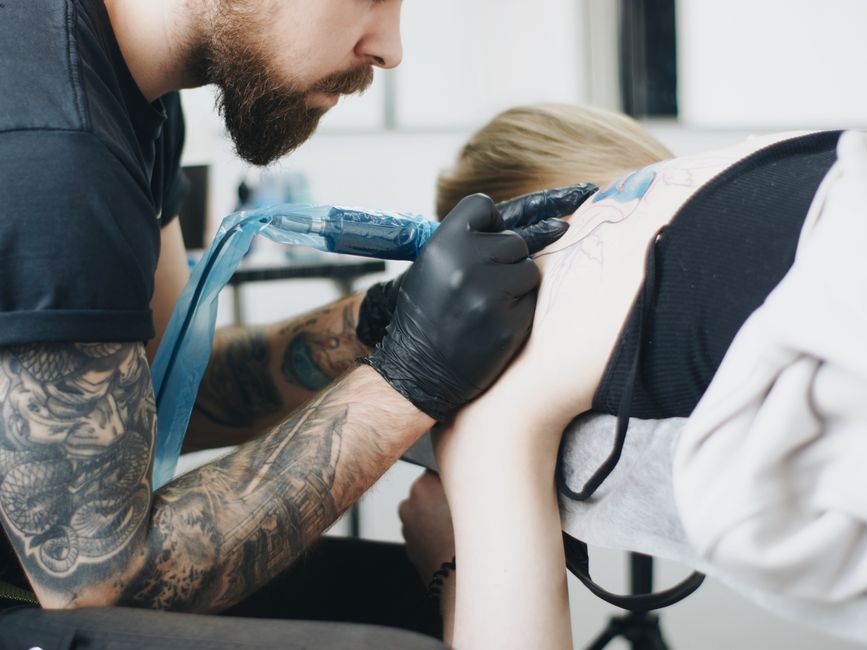
Tattooing is a physical craft. You learn it through repetition, real skin and live correction from a Mentor, and no video or lecture can replace that.
You can read about needle depth all night. But once your machine touches real skin, everything changes: the pull, the stretch, the client’s breathing, the healing. Those lessons stick through your hands, not your notes. A Mentor also catches mistakes before they turn into habits.
This is also why tattooing is an AI-proof career. Software can generate a design, but it can’t read a nervous client, adjust to living skin or earn someone’s trust in the chair. We dig into this in our article on why Tattoo Artists are still essential.
The demand for that human skill is real. According to Pew Research Center, 32% of Americans have a tattoo, and 22% have more than one.
What does a short tattoo course miss?
A short tattoo course misses the reps, the real-client experience and the long-term relationship with a Mentor. Those are the things that turn knowledge into a working skill.
Here’s what usually falls through the cracks:
- Live client work: Nothing builds confidence like a real person trusting you with their skin. In states that set training hours, practical client work is part of the requirement.
- Sanitation in practice: Reading the American Academy of Dermatology’s tips for caring for tattooed skin is one thing. Coaching a client through healing and running safe tattoo studio routines every day is another.
- Business foundations: Booking, pricing, portfolio building and growing a following. Explore these platforms to help new and aspiring Tattoo Artists build their brand.
- Mistake prevention: A Mentor stops bad habits early. Learn more about the mistakes aspiring tattoo apprentices should avoid.
- Equipment mastery: Knowing your gear takes time with it in your hands. Start with these tools every beginner Tattoo Artist should know.
How do you choose the right path step by step?
Start with your state’s licensing rules, then find training that meets them. Prioritize documented, supervised, hands-on hours over quick certificates.
Step 1: Confirm your state’s rules. Check whether your state, county or city requires training hours, a safety course, registration or all three.
Step 2: Define your goal. Curiosity points to a course. A real, income-earning career points to a tattoo apprenticeship.
Step 3: Verify supervised hours. Ask whether a licensed Mentor will oversee your work on real clients.
Step 4: Check for licensing support. Serious training helps you meet state requirements and keep your documentation in order.
Step 5: Look at the people. Who are the Mentors, and what’s the tattoo studio culture like? Mentorship quality matters more than marketing.
Step 6: Ask what happens after training. Find out whether you’ll finish job-ready and whether there’s a clear path to work.
How long does each path take?
A tattoo course can last a few hours to a few weeks. A full tattoo apprenticeship typically takes 18 to 24 months, because real skill can’t be rushed.
The state examples show the gap. California’s required safety training starts at two hours. Arkansas’s training requirement is 375 hours, and Oregon’s approved course is 360 hours. A tattoo apprenticeship goes further still, building the speed, consistency and client experience tattoo studios expect.
Two years can sound long when you’re eager to start. But compare it to a four-year degree that often leaves graduates in debt and unsure of their next step. That’s why tattoo apprenticeships are gaining ground as a solid alternative to college.
What does Ink Different’s Traditional Tattoo Apprenticeship offer?
Ink Different’s Traditional Tattoo Apprenticeship takes 18 to 24 months and runs through four phases. It builds you from beginner to job-ready with licensing support and in-person mentorship inside working tattoo studios.
Here’s what you can expect:
- Four-phase structure: Personalized, hands-on training that moves at the pace of real skill.
- Training at 60+ tattoo studios nationwide: You learn in person, under a Mentor, in a working tattoo studio.
- Built for beginners: No prior art experience is required. We teach the craft from drawing fundamentals to client care.
- Licensing support and job-ready skills: You finish prepared to work professionally and meet your state’s requirements.
- A guaranteed job offer: Graduates receive a guaranteed job offer at one of Ink Different’s own tattoo studios.
- Interest-free payment plans: Flexible payments make training more accessible.
- Community culture: Our “Good Humans” culture means a supportive, family-like community that has your back from your first line.
What is the Master Mentorship program?
The Master Mentorship is a one-year, in-person training path for beginners and experienced Tattoo Artists. It’s built for mastering a specific style, growing your career and building your own business.
You’ll train alongside celebrity and award-winning Master Mentors, including Al Fliction, Liz Cook, Kyle Dunbar, Boneface, Jordi Pla and Marcel Oliveira. It’s intensive and focused, designed for Tattoo Artists who want to level up with industry leaders beside them.

Ready to get licensed and working?
If you want a real career and a legitimate path to getting licensed, supervised hands-on training beats a short tattoo course every time. Check your state’s rules, then choose training that gives you the supervised hours, licensing support and real client experience tattoo studios look for.
Ink Different offers training at 60+ tattoo studios nationwide, including Spanish-speaking locations in Denver, Orange County, NYC, Miami, San Antonio and San Diego. Each Mentor takes just two tattoo apprentices per tattoo studio, so seats fill up quickly.
Ready to become a Tattoo Artist? Apply now to Ink Different’s Traditional Tattoo Apprenticeship and start building an AI-proof career with licensing support along the way.
Frequently Asked Questions
Does a tattoo course get you licensed?
Usually not on its own. Many states require a bloodborne pathogens course, but it covers safety, not tattooing. States that set training hours, like Arkansas and Oregon, require supervised practical work too.
Is a bloodborne pathogens course the same as a tattoo course?
No. A bloodborne pathogens course teaches infection control and exposure prevention. It’s often required for licensing or registration, but it doesn’t teach you how to design or apply a tattoo.
How long does a tattoo apprenticeship take?
A tattoo apprenticeship typically takes 18 to 24 months. Ink Different’s Traditional Tattoo Apprenticeship uses a four-phase structure built around real skill development and licensing readiness.
Do I need art experience to start a tattoo apprenticeship?
No. Ink Different’s Traditional Tattoo Apprenticeship is built for beginners. It teaches drawing, machine handling and fundamentals from phase one.
What makes Ink Different different from a tattoo course?
Ink Different offers 15 years of experience, in-person mentorship, award-winning Master Mentors, a “Good Humans” community, licensing support, interest-free payment plans and a guaranteed job offer at one of Ink Different’s own tattoo studios.
Where can I do a tattoo apprenticeship near me?
Ink Different offers the Traditional Tattoo Apprenticeship at 60+ tattoo studios nationwide. Spanish-speaking locations are available in Denver, Orange County, NYC, Miami, San Antonio and San Diego.
