

Apprentice Spotlight: Alex McLean on Relearning How to Draw for Tattooing in Phase One
Key Takeaways
Who is Alex McLean and why did he start over?
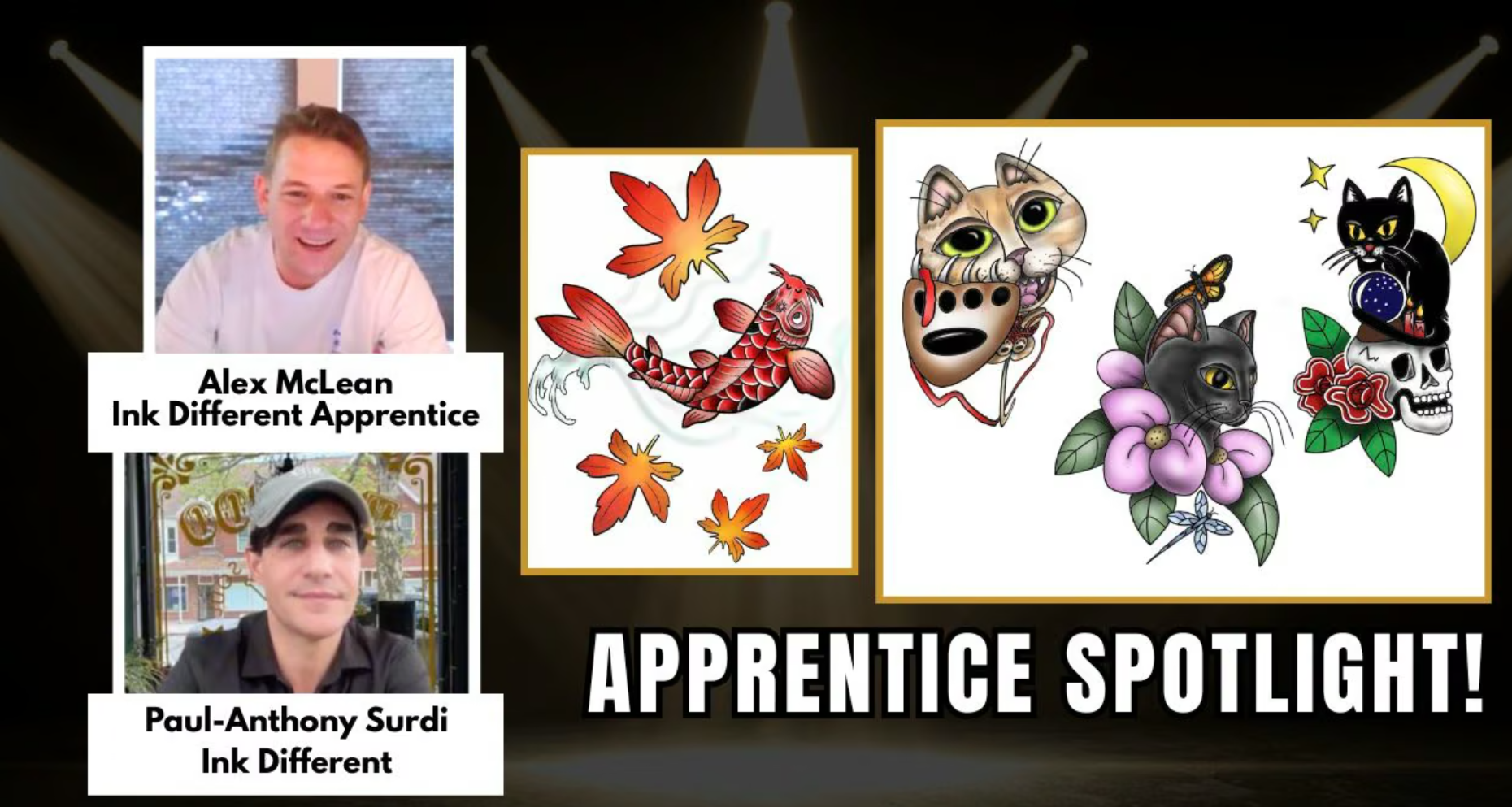
Alex McLean is an Ink Different apprentice who returned to art after about 10 years away.
He studied business at a liberal arts college. His college art teachers noticed his sketches and asked why he was a business major. Still, he spent the next decade in the corporate world and running his own flooring business.
Then came a hard stretch in his life. He lost good friends and family members. Thus, he needed an outlet, so he went back to his roots. He started painting, then tried tattooing on synthetic skin. “I was just trying to create something different, something cool,” he says, “and really just fell in love with the tattoo aspect.”
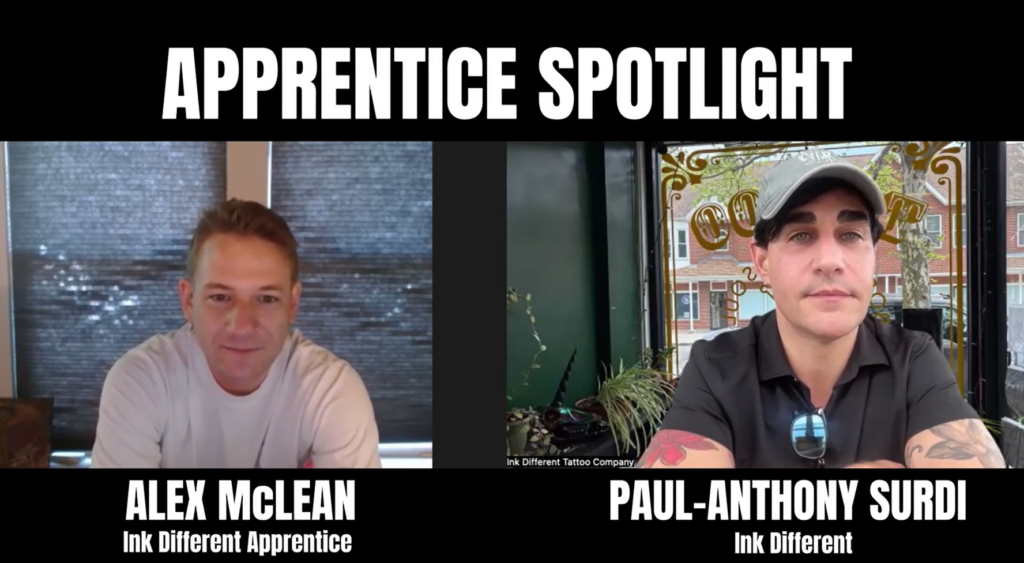
When Tattoo Artists told him he’d have to hang around tattoo shops for years doing menial tasks to get started, he searched online for a better path and found Ink Different.
Why do tattoo apprentices have to relearn how to draw?
Because a tattoo design has to work as a tattoo, not just as a drawing.
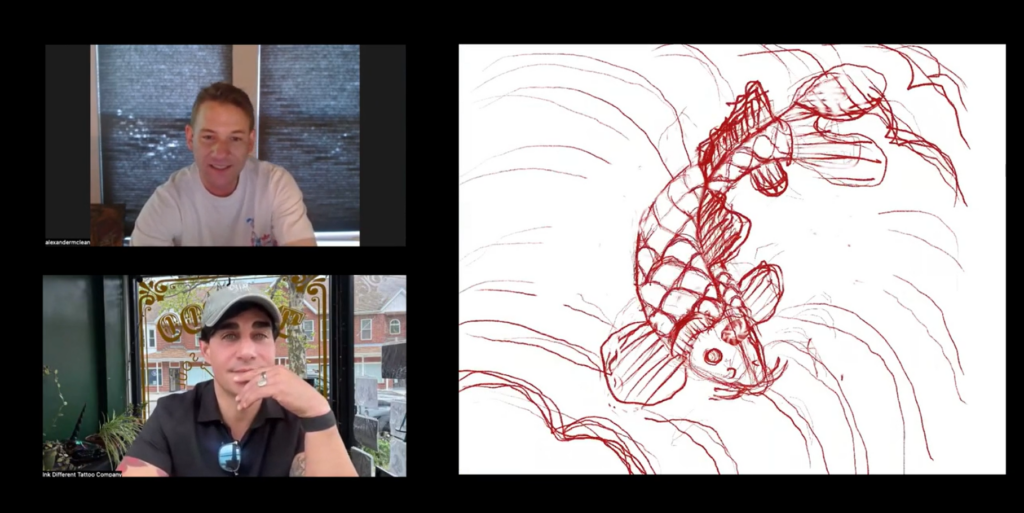
For Alex, that meant learning to think ahead. Instead of sketching freely, he had to picture how the foundational lines and outlines would translate into the final tattoo.
It also meant accepting each style’s boundaries. American traditional, for example, uses strict, consistent line weights and basic figures. “That’s when your mindset has to switch,” Alex says, “from art to tattoo art.”
There’s also the permanence. Before his training, Alex worried about that risk. “If you mess up, then that’s on that person forever,” he says. His training helped turn that fear into confidence.
Mentor Tip: Your drawing skills still matter. Phase One teaches you how to shape them for tattooing.
What happens in Phase One of Ink Different’s tattoo apprenticeship?
In Ink Different’s Traditional Tattoo Apprenticeship, Phase One is art and design. It happens online, before apprentices ever pick up a tattoo machine.
For Alex, Phase One included:
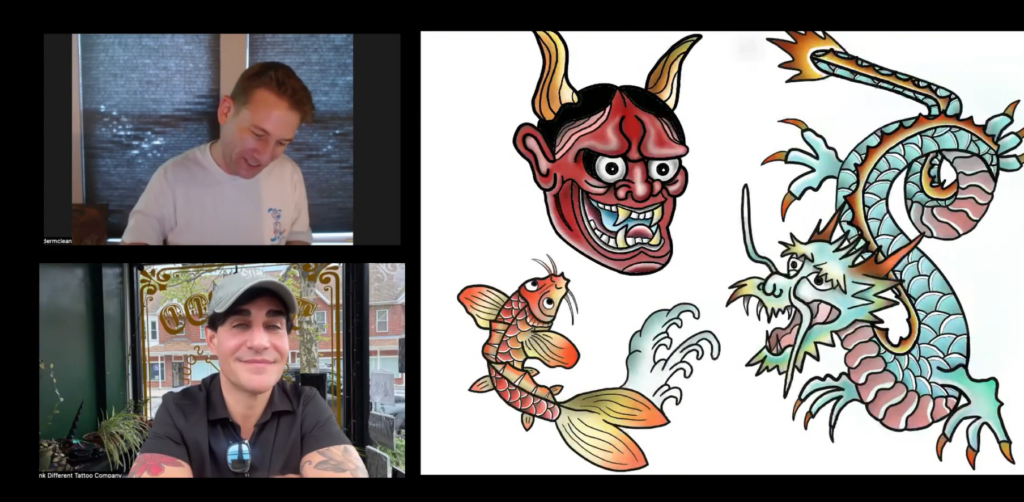
- Designing in several styles: American traditional, neo-traditional, and new school, among others.
- Starting with simple shapes: For American traditional, he learned to build from circles, squares, and triangles.
- Working on paper and in Procreate: Two very different tools, each with its own challenges.
- Learning from multiple instructors: He worked with three instructors, plus a fourth near the end. Each brought their own twist.
He was surprised to learn that all of his instructors are working Tattoo Artists. He also values the network he’s building with future colleagues.
How do you relearn drawing for tattooing step by step?
Here’s how Alex approached it:
Step 1: Start with basic shapes. For American traditional, he built designs from simple circles, squares, and triangles.
Step 2: Make every figure strong. Simple doesn’t mean easy. “You can’t do it crappily,” he says.
Step 3: Learn your digital tools. Procreate was frustrating at first. Once he learned enough to keep going, it became fun, and it made his design process faster and more portable.
Step 4: Respect the paper. On paper, one tiny slip of the pen could ruin an almost perfect sheet. Sometimes he ended up with tall stacks of paper.
Step 5: Use critiques to sharpen each style. His instructors pointed out when a design drifted into another style. That feedback made his work stronger.
Step 6: Draw every day. Tight lines rely on small muscles, and they used to hurt. Now he draws at least a little every day to keep them strong.
For supplies, see the tools every beginner Tattoo Artist should know.
What mistakes do new apprentices make with drawing?
Alex’s experience points to a few common challenges.
Blending styles
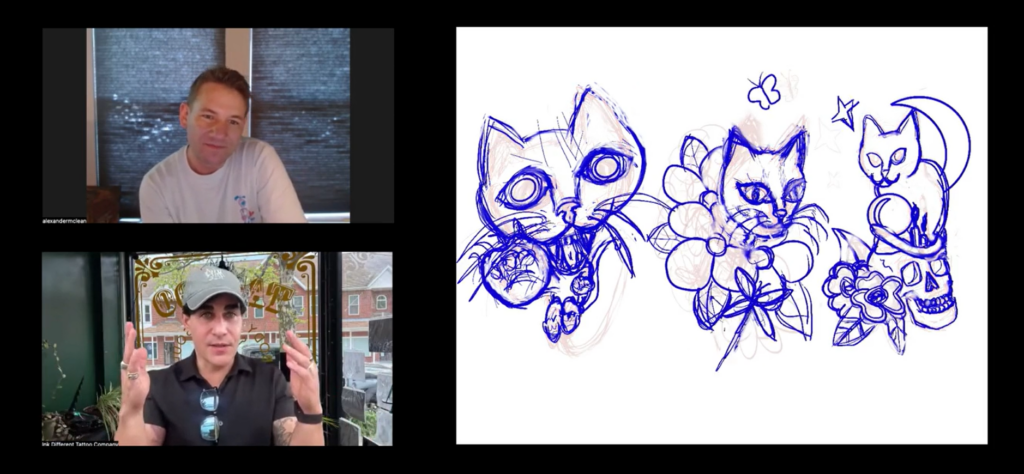
At first, his American traditional piece looked a little too neo-traditional, and his neo-traditional piece looked a little too traditional. His instructors helped him sort out the differences. Their input made his neo-traditional cat face much stronger. For his new school cat, from a three-styles assignment, they told him to keep doing his thing. It’s now one of his favorite pieces.
Thinking you’re already the best
Alex says attitude matters. “If people think going in that they are the best at something, then they’re probably not going to work out at it,” he says. “But if you go with the open mindset, absolutely.”
Giving up when a style doesn’t click
Alex says you can be crushing it, then hit a style your brain hasn’t figured out yet. Suddenly you wonder if you even know how to draw. But if you keep at it, that piece often turns into one of your best.
Read more about the mistakes aspiring tattoo apprentices should avoid.
How does Ink Different structure Phase One training?
Phase One is the first of four phases in Ink Different’s Traditional Tattoo Apprenticeship, an 18 to 24 month tattoo apprenticeship built for beginners.
- Phase One: Art and design, online. This is where Alex is now.
- Phase Two: Machine practice on synthetic skin, online. Alex will soon move from digital designs to using needles on practice pads.
- Phase Three: Supervised tattoos on real clients in a tattoo studio.
- Phase Four: Building independence and preparing for licensing.
No prior art experience is required. Ink Different has trained Tattoo Artists for 15 years, with a “Good Humans” culture at its core. Safety is part of the training, too, including the OSHA bloodborne pathogens standard.
This is a career that comes with confidence. You’ll finish with job-ready skills, licensing support, and a guaranteed job offer at one of Ink Different’s own tattoo studios. The Traditional Tattoo Apprenticeship is available at 60+ tattoo studios nationwide.
What is the Master Mentorship option?
Once you’ve built your foundation, Ink Different’s Master Mentorship connects you with Master Mentors, including Al Fliction, Liz Cook, Kyle Dunbar, Boneface, Jordi Pla, Marcel Oliveira, and Kara Gutierrez.
Ink Different also offers Spanish-speaking locations in Denver, Orange County, NYC, Miami, San Antonio, and San Diego.
Ready to relearn how to draw for tattooing?
Alex McLean spent Phase One rethinking how he draws, from building strong American traditional figures to learning Procreate. Now he’s ready to take those designs into Phase Two.
What keeps him going is the end goal. “This is the dream,” he says. “Just stay focused and keep going, and it’ll become second nature.” He keeps picturing himself at the tattoo shop, tattooing.
Seats are limited, with only two apprentices per tattoo studio per Mentor.
Ready to become a Tattoo Artist? Apply now to Ink Different’s Traditional Tattoo Apprenticeship and start building an AI-proof career with licensing support and a guaranteed job offer at one of Ink Different’s own tattoo studios.
Frequently Asked Questions
Do I need to know how to draw before starting?
No. Alex had an art background, but the Traditional Tattoo Apprenticeship teaches drawing for tattooing from the beginning.
Why do experienced artists still find Phase One challenging?
Alex says designing for tattoos means thinking ahead to the final tattoo and following each style’s rules, like American traditional’s strong, consistent lines.
Do apprentices use a tattoo machine in Phase One?
No. Phase One is art and design. Machine practice starts in Phase Two.
What was Alex’s hardest Phase One assignment?
His first American traditional piece on paper, because the basic figures still had to be strong.
How long does the Traditional Tattoo Apprenticeship take?
Ink Different’s Traditional Tattoo Apprenticeship takes 18 to 24 months across four phases, with licensing support and a guaranteed job offer at one of Ink Different’s own tattoo studios.
Where can I do a tattoo apprenticeship near me?
The Traditional Tattoo Apprenticeship is available at 60+ tattoo studios nationwide, including Spanish-speaking locations in Denver, Orange County, NYC, Miami, San Antonio, and San Diego.
