
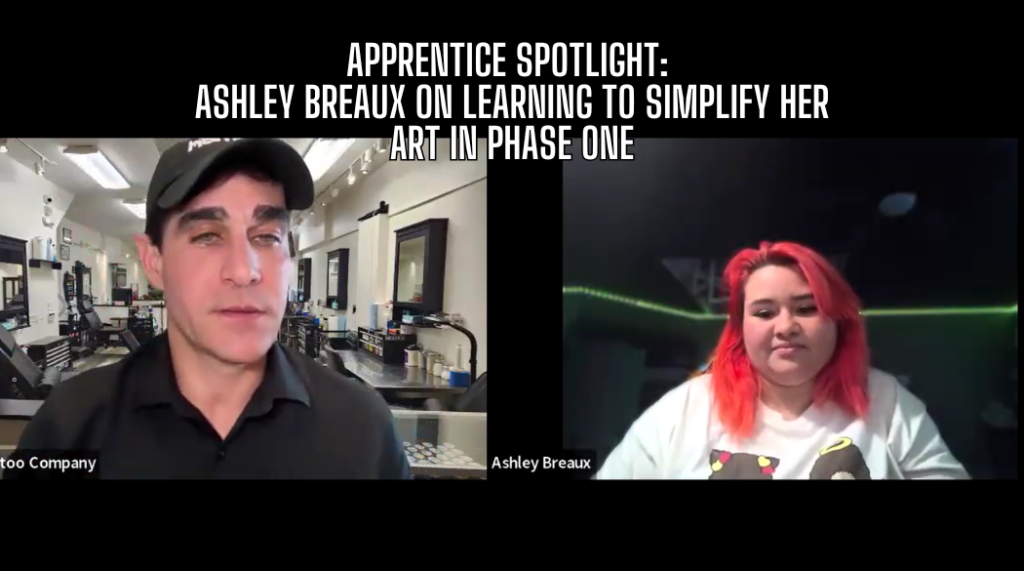
Apprentice Spotlight: Ashley Breaux on Learning to Simplify Her Art in Phase One
Ashley finished Phase One of Ink Different’s Traditional Tattoo Apprenticeship in about five or six weeks and is training toward Ink Different’s location in Tampa, Florida. In her Apprentice Spotlight interview, she explained how she learned to simplify.
Key Takeaways
Who Is Ashley Breaux?
Ashley Breaux is an Ink Different apprentice in Tampa, Florida, where she’ll train with her Mentor, Destiny.
She’s loved art her whole life. She spent three years in art school studying biomedical illustration, the detailed scientific artwork used in textbooks, before leaving because of the cost. She then joined the military, where she designed tattoos for fellow service members and fell in love with tattoo design.
That background made her strong at detail. Phase One taught her when to hold back.
What Is Phase One of a Tattoo Apprenticeship?
In Ink Different’s Traditional Tattoo Apprenticeship, Phase One is art and design. It happens online, through live classes with working Tattoo Artists, before apprentices pick up a tattoo machine.
Apprentices design in four foundational styles: American traditional, neo-traditional, new school, and Japanese. Then they create a piece of their own choice. Ashley had never worked in any of these styles before.
How Ashley approached Phase One
Ashley joined classes almost every day. “I don’t have a job,” she says. “I get paid to stay at home.” With the free time, she sat in on classes even when she had nothing to submit, just to listen. “Even though it may not apply to me now, it may apply to me later,” she says.
Why Did Ashley Need to Simplify Her Art?
Because tattooing comes with limits that illustration doesn’t.
“I’m so used to doing intricate illustration stuff,” Ashley says. Her instructors told her to simplify “so it’s easier for you to actually execute it in less time.”
She came to understand why. “You want to do some really cool stuff,” she says, “and it’s like, well, I don’t know how to tattoo yet.” Complex designs are very hard at first. “You’re going to be stuck there for hours doing complex work.”
Mentor Tip: As the interviewer pointed out, tattooing has no undo button. Every design has to translate to skin, and Procreate makes it easy to zoom in and add tiny details that won’t work on the body.
Getting caught up in too much detail is one of the most common early mistakes new apprentices make.
How Do You Actually Simplify a Design?
Ashley’s Phase One work offers a practical approach:
- Sketch in red pencil first. Ashley roughs out ideas in red to see where things should go and how the composition looks.
- Check the flow. “My main prerogative is to make sure everything the eye is flowing through it nicely, instead of one major thing,” she says.
- Edit before you commit. Red pencil sketches give you room to change things before finalizing.
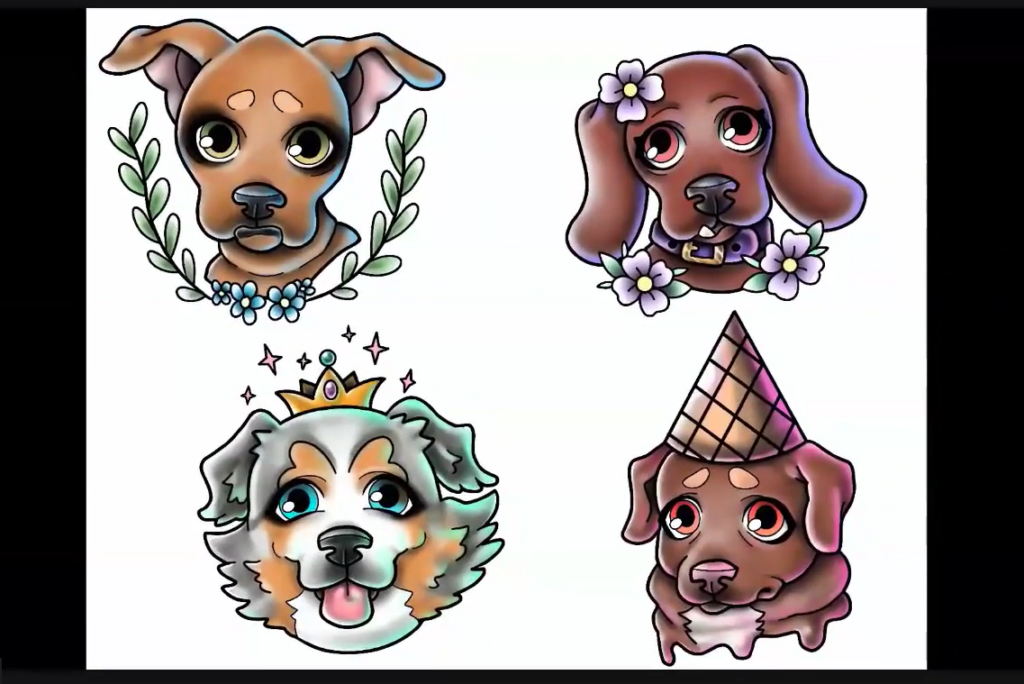
- Keep detail executable. Her pet portraits push detail to the edge without going past what can be tattooed.
- Learn from different techniques. Her instructors showed her different approaches on the iPad and on paper.
- Listen to critiques. Ashley found that a second set of experienced eyes catches what you miss when you’ve been staring at your own work.
As she gets ready for Phase Two, she’ll start learning the equipment Tattoo Artists use every day, which is where simple, well-planned designs really pay off.
Ashley’s Phase One pieces
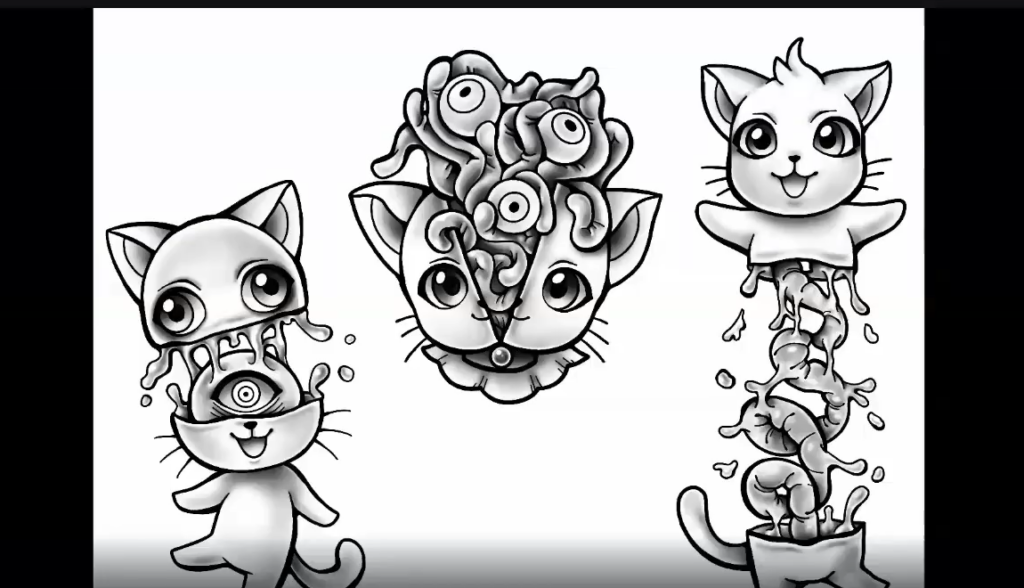
- New school: For Halloween, she combined two things she loves, cute art and a little horror.
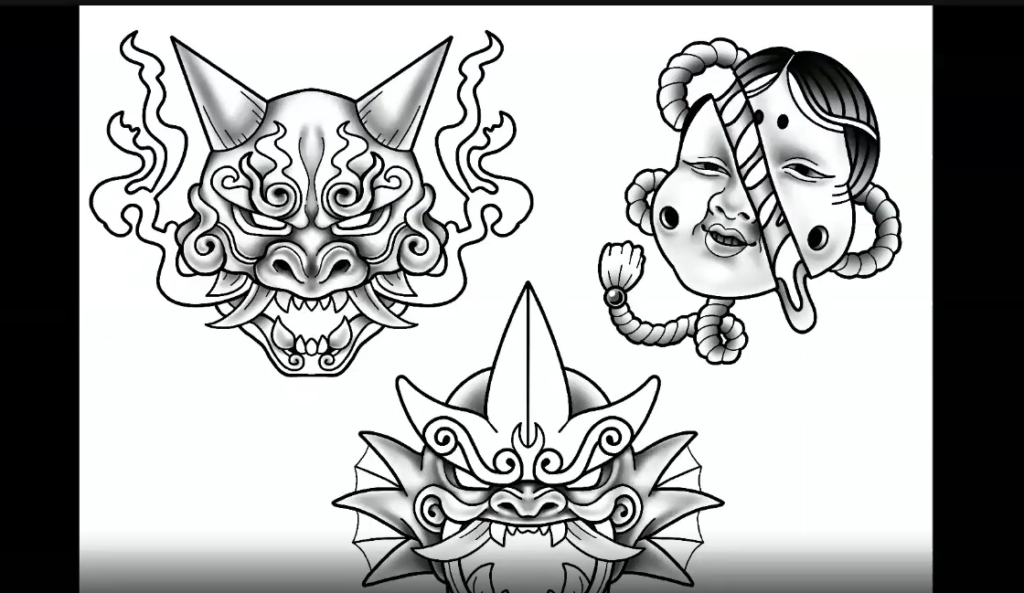
- Japanese: A color Japanese piece. She was surprised how similar Japanese is to American traditional.
- Personal choice: Four dogs in a whimsical new school style, inspired by a friend’s suggestion to do pet portraits. Two are her dogs and two are her friend’s.
What Changed for Ashley in Phase One?
Her artwork improved, and so did her confidence.
“They gave me really good critiques, and it made my artwork actually better,” she says of her instructors.
She also found a style she didn’t expect to enjoy. “I was surprised that I actually liked neo-traditional,” she says. “It was out of my comfort zone, and I actually did enjoy it.” Compared to the simplicity of American traditional, neo-traditional felt like “a step up.”
She moved through Phase One in about five or six weeks, without rushing. Her instructors, including Julian and Matt, made sure of it, and sometimes even told her to take a break.
Now she’s ready for what’s next. “I’m not really nervous about Phase Two,” she says. “Everything made me really confident and feel like I can do this.”
Why Does Live Mentorship Make the Difference?
For Ashley, live classes with experienced Tattoo Artists made all the difference.
“Martin and Julian were so helpful,” she says. “Having a second eye is so helpful, especially someone who’s already experienced.” She especially likes that Julian is “to the book.”
She compares it to art school, where critiques were harsh and deadlines were packed. “Here with Ink Different, you get to pick your time frame,” she says. “You don’t feel pressured.” She also found the instructors relatable, especially Matt, whom she calls hilarious.
That human guidance is part of what makes Tattoo Artists irreplaceable. Ashley sees it in tattooing itself, too. “A tattoo is something permanent,” she says, “but it’s also a story to tell.”
What Is Ink Different’s Traditional Tattoo Apprenticeship?
Ink Different’s Traditional Tattoo Apprenticeship is an 18 to 24 month, four-phase tattoo apprenticeship built for beginners. Ink Different has trained Tattoo Artists for 15 years. No prior art experience is required.
- Phase One: Art and design, online.
- Phase Two: Machine practice on synthetic skin, online. Ashley will train with the same instructors, plus Ruby and Destiny.
- Phase Three: Supervised tattoos on real clients in a tattoo studio.
- Phase Four: Building independence and preparing for licensing.
Safety is part of the training, including the OSHA bloodborne pathogens standard.
This is a career that comes with confidence. You’ll finish with job-ready skills, licensing support, and a guaranteed job offer at one of Ink Different’s own tattoo studios. The Traditional Tattoo Apprenticeship is available at 60+ tattoo studios nationwide.
After three costly years of art school, Ashley’s experience shows why so many people see a tattoo apprenticeship as a smart alternative to college.
What Is the Master Mentorship?
Once you’ve built your foundation, Ink Different’s Master Mentorship connects you with Master Mentors, including Liz Cook, Kara Gutierrez, Joey Tattoo, Boneface, Jordi Pla, Kyle Dunbar, James Vaughn, Big Jaz, Marcel Oliveira, Big Ceeze, Al Fliction, BillyJack Gunter, Javi Antunez, and Sebastian Murphy.
Ashley isn’t ready to specialize yet. She wants to do a bit of everything, since her husband only gets black and gray while others love color. That range will help when she starts marketing her work as a Tattoo Artist.
Making Tattoo Artist Training Accessible for Everyone
Ink Different offers Spanish-speaking locations in:
- Denver
- Orange County
- New York City
- Miami
- San Antonio
- San Diego
Seats are limited, with only two apprentices per tattoo studio per Mentor.
Ready to Become a Tattoo Artist?
Ashley Breaux’s biggest Phase One lesson was simple: let your designs do less, so you can tattoo them well. “I know it’s going to be hard,” she says of what’s ahead. “Everything is hard when you start it. But with all this help, the end result is always worth it.”
Ready to become a Tattoo Artist? Apply now to Ink Different’s Traditional Tattoo Apprenticeship and start building an AI-proof career with licensing support and a guaranteed job offer at one of Ink Different’s own tattoo studios.
Frequently Asked Questions
Why did Ashley need to simplify her designs?
Her instructors said simpler designs would be easier and faster for her to actually tattoo. Complex work is very hard when you’re still learning.
Do I need prior art experience to start Phase One?
No. Ashley had an art background, but the Traditional Tattoo Apprenticeship teaches design fundamentals from the beginning.
How long did Ashley take to finish Phase One?
About five or six weeks. She attended classes almost every day without rushing.
How long does the Traditional Tattoo Apprenticeship take?
Ink Different’s Traditional Tattoo Apprenticeship takes 18 to 24 months across four phases, with licensing support and a guaranteed job offer at one of Ink Different’s own tattoo studios.
What style surprised Ashley most?
Neo-traditional. She didn’t know much about it before Phase One, and she ended up enjoying it.
Do apprentices use a tattoo machine in Phase One?
No. Phase One is art and design. Machine practice starts in Phase Two.
