

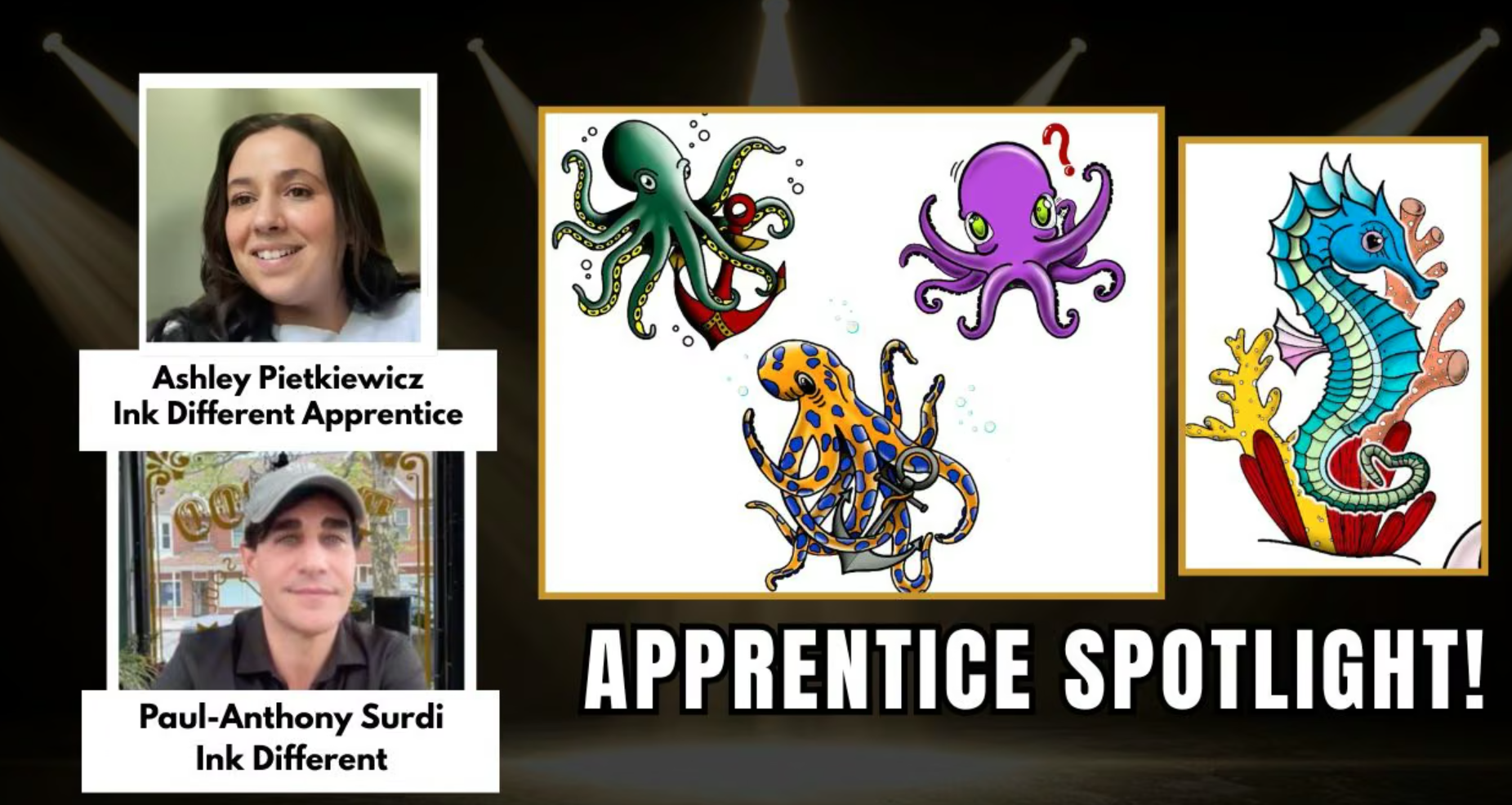
Apprentice Spotlight: Ashley Pietkiewicz on Learning Every Phase One Style, From American Traditional to Japanese
Key Takeaways
Who is Ashley Pietkiewicz?
Ashley Pietkiewicz is a medical assistant from Queens, New York, who has worked in medicine for 10 years, including LGBTQIA+ care. She’s now training as a tattoo apprentice while working, and while raising a young daughter with her husband.
She’s always loved art. Friends began asking her to draw designs for their tattoos, and over time, the people around her told her to “cut out the middleman” and become a Tattoo Artist herself.
Her medical background has helped in unexpected ways. She already understood strict sanitation. And she found the structure of her tattoo apprenticeship, with classes followed by in-studio work, very similar to the schooling she did for her medical license in New York.
What is Phase One style training?
Phase One of Ink Different’s Traditional Tattoo Apprenticeship is art and design. Apprentices work through the major tattoo styles, first on paper and then digitally. It all happens online, before apprentices use a tattoo machine.
Here’s the order Ashley followed:
- American traditional, on paper
- Neo-traditional
- Digital work on the iPad, starting with American traditional again
- New school
- Japanese traditional, with the choice of paper or digital
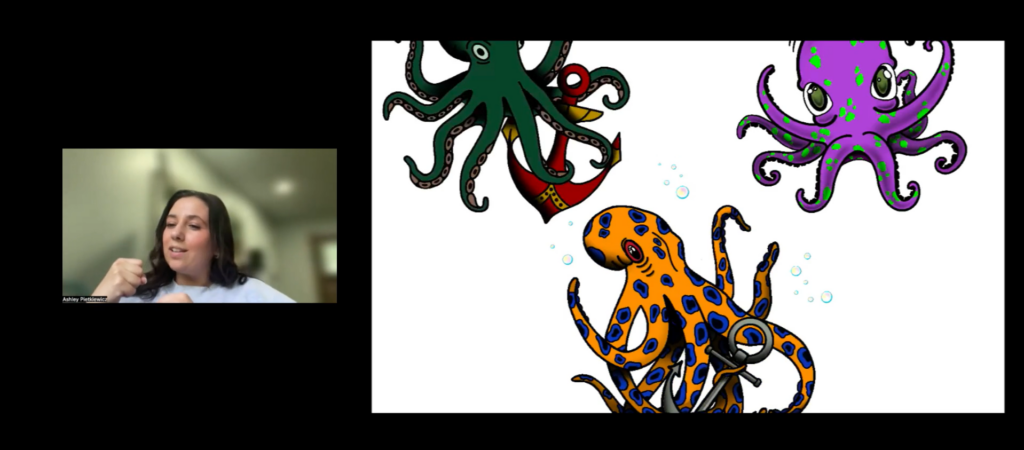
- Three styles, one subject, a review of everything so far
- Freestyle, her next step
Each assignment starts the same way, with a red pencil sketch, whether on paper or digital.
Why learn every Phase One style instead of just one?
Ashley’s experience shows a few benefits.
- You find out what you love. Ashley didn’t know she’d connect so strongly with Japanese traditional until she drew it.
- You grow in unexpected places. New school pushed her far outside her comfort zone, and she came out proud of her work.
- You build a foundation for freestyle. After learning every style, apprentices get to choose. Some revisit styles they found hard, while others lean into what they love.
Before you start, read about the mistakes aspiring tattoo apprentices should avoid.
What did Ashley learn from American Traditional?
American traditional was where Ashley started, on paper. It’s the old-school sailor style, known for bold designs.
What she loves most is how feminine subjects look in such a bold style. American traditional was also the first style she redid digitally, once apprentices moved to the iPad.
From there, she moved into neo-traditional, which adds more fine detail. She’s been amazed by the neo-traditional work her classmates create.
Pro Tip: Ashley says seeing classmates’ work is better than searching online for inspiration. You see exactly what the assignment requires, plus the whole creative process.
How did Japanese tattooing stretch Ashley’s skills?
Japanese traditional actually came naturally to Ashley. She says she really clicks with it, especially its use of color.
Since apprentices could choose paper or digital for this style, she did one piece of each.
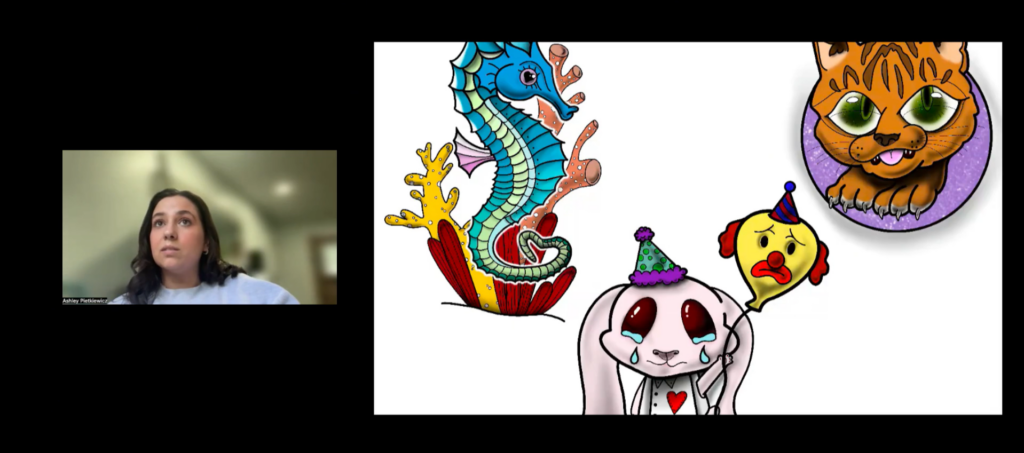
The style that truly stretched her was new school. “I had never drawn anything like that before,” she says. It’s funky and imaginative, with many directions to take it. With help from her classmates’ examples, her own research, and her instructors, she got there. “I ended up really loving some of the pieces I did,” she says. “Two of the pieces I did draw, I would absolutely get tattooed on myself.”
How can you learn multiple tattoo styles the right way?
Here’s what worked for Ashley:
Step 1: Start on paper. Ashley began with American traditional on paper before moving to digital.
Step 2: Move to digital. Redoing American traditional on the iPad helped her learn the new tools.
Step 3: Learn from your classmates. Classes include apprentices at different stages. Ashley could see work from people finishing Phase One, which showed her where she was headed. Now she enjoys watching newer apprentices share their first pressure sheets.
Step 4: Choose your instructors with purpose. Ashley has learned from instructors including Martin, Jake, and Julian. Each has a different approach. She knows Julian will give her the constructive criticism she needs.
Step 5: Push through the hard styles. New school challenged her most, and it became some of her proudest work.
Step 6: Review it all. The three-styles assignment brings everything together.
For supplies, see the tools every beginner Tattoo Artist should know.
How does Ink Different train you across every style?
Ink Different’s Traditional Tattoo Apprenticeship is an 18 to 24 month, four-phase tattoo apprenticeship built for beginners. Ink Different has trained Tattoo Artists for 15 years.
- Phase One: Art and design across the major styles, online.
- Phase Two: Machine practice on synthetic skin, online.
- Phase Three: Supervised tattoos on real clients in a tattoo studio.
- Phase Four: Building independence and preparing for licensing.
Ashley was a little shy when she started, but she felt welcome right away. Her very first class was with Martin, and she left excited enough to sign up for another class the next day. She also loves the mix of people in her classes and says all of her instructors have been fantastic.
Safety is part of the training, including the OSHA bloodborne pathogens standard.
This is a career that comes with confidence. You’ll finish with job-ready skills, licensing support, and a guaranteed job offer at one of Ink Different’s own tattoo studios. The Traditional Tattoo Apprenticeship is available at 60+ tattoo studios nationwide.
Tattooing is a lasting, human craft. As the interviewer noted, with everything happening in AI, it’s one field “we’re pretty confident it’s still going to be here.” Read more on why Tattoo Artists are still essential, and why tattoo apprenticeships are gaining ground as a solid alternative to college.
What if you want to specialize later?
Once you’ve built your foundation, Ink Different’s Master Mentorship connects you with Master Mentors, including Al Fliction, Liz Cook, Kyle Dunbar, Boneface, Jordi Pla, Marcel Oliveira, and Kara Gutierrez.
Making tattoo training accessible for everyone
Ink Different offers Spanish-speaking locations in Denver, Orange County, NYC, Miami, San Antonio, and San Diego.
Ready to start your own journey?
Ashley Pietkiewicz went from drawing designs for friends to working through every Phase One style, all while working in medicine and raising her daughter. She says once you take the leap, it becomes “so worth it.”
“It’s the thing that I look forward to doing,” she says. “Coming home from work and going into my space and starting to draw and go to classes.”
Seats are limited, with only two apprentices per tattoo studio per Mentor.
Ready to become a Tattoo Artist? Apply now to Ink Different’s Traditional Tattoo Apprenticeship and start building an AI-proof career with licensing support and a guaranteed job offer at one of Ink Different’s own tattoo studios.
Frequently Asked Questions
What styles are covered in Phase One?
American traditional, neo-traditional, new school, and Japanese traditional, followed by a three-styles review and a freestyle assignment.
Do apprentices draw on paper or digitally?
Both. Ashley started on paper, then moved to the iPad. For Japanese traditional, she did one piece of each.
Which style challenged Ashley most?
New school. She had never drawn anything like it, but ended up loving her results.
Do I need art experience to start?
No. The Traditional Tattoo Apprenticeship is built for beginners.
How long does the Traditional Tattoo Apprenticeship take?
Ink Different’s Traditional Tattoo Apprenticeship takes 18 to 24 months across four phases, with licensing support and a guaranteed job offer at one of Ink Different’s own tattoo studios.
Can I train while working full-time?
Yes. Ashley works as a medical assistant and takes as many classes as she can around her schedule.
