

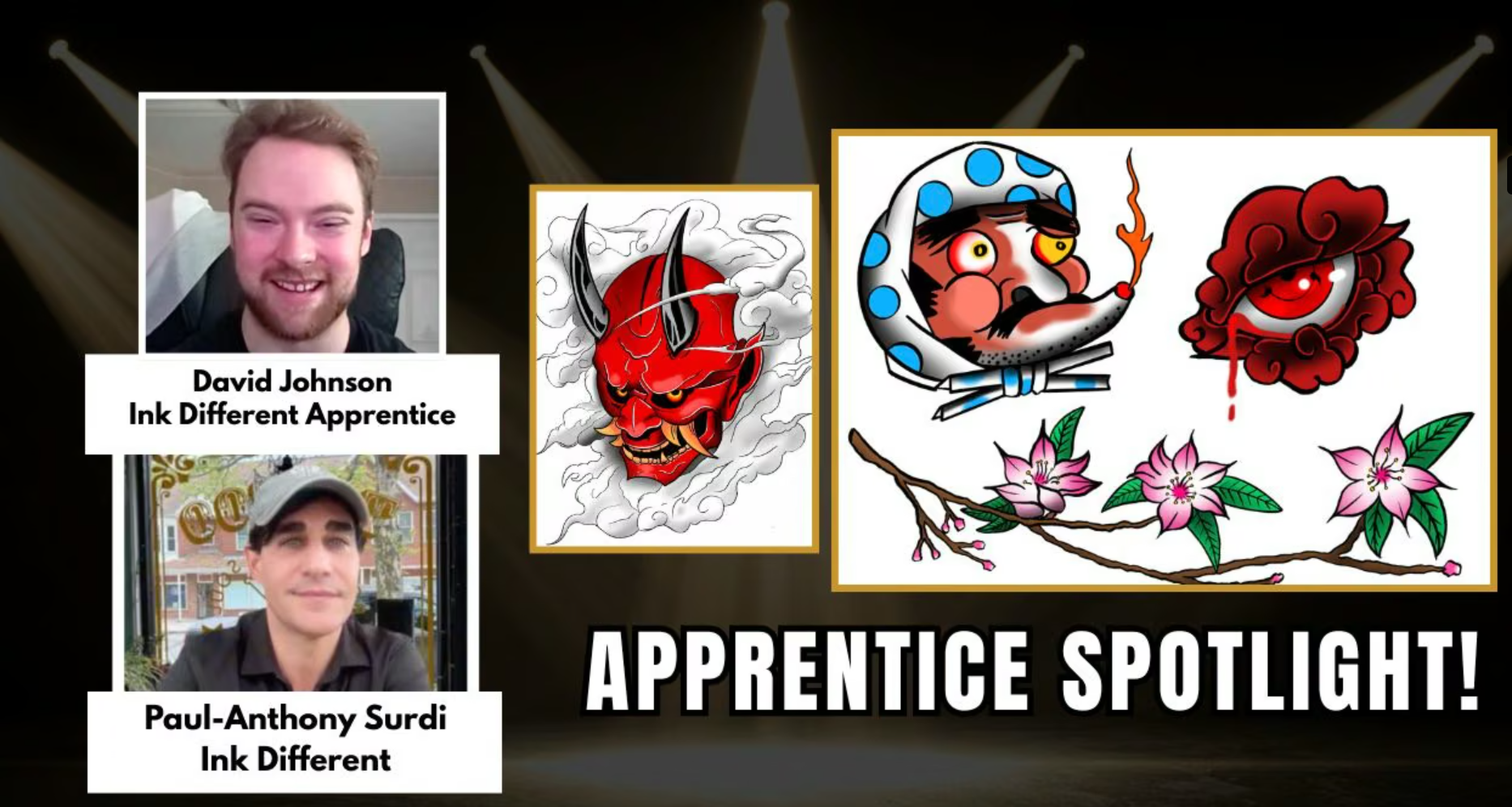
Apprentice Spotlight: David Johnston on Phase Two, Depth, Stability, and One Line at a Time
David is an apprentice in Ink Different’s Traditional Tattoo Apprenticeship in Colorado. In his Apprentice Spotlight interview, he shared how he’s pushing through Phase Two.
Key Takeaways
Who Is David Johnston and Why Does His Story Matter?
David Johnston is an Ink Different apprentice in Colorado. He spent about five years in college, switching from computer science to fine arts.
His story matters because it shows that even strong art skills don’t automatically transfer to a tattoo machine. David moved through Phase One quickly, since it felt a lot like his college illustration courses. Phase Two asked him to build an entirely new skill.
He’s also honest about how it felt. At first, he was a little frustrated to be starting over after years of school. But once he got into the work, he realized he was having fun learning something new and seeing real progress.
What Is Phase Two of a Tattoo Apprenticeship?
In Ink Different’s Traditional Tattoo Apprenticeship, Phase Two is where apprentices learn the tattoo machine. It happens online, with apprentices practicing on synthetic skin, or practice pads.
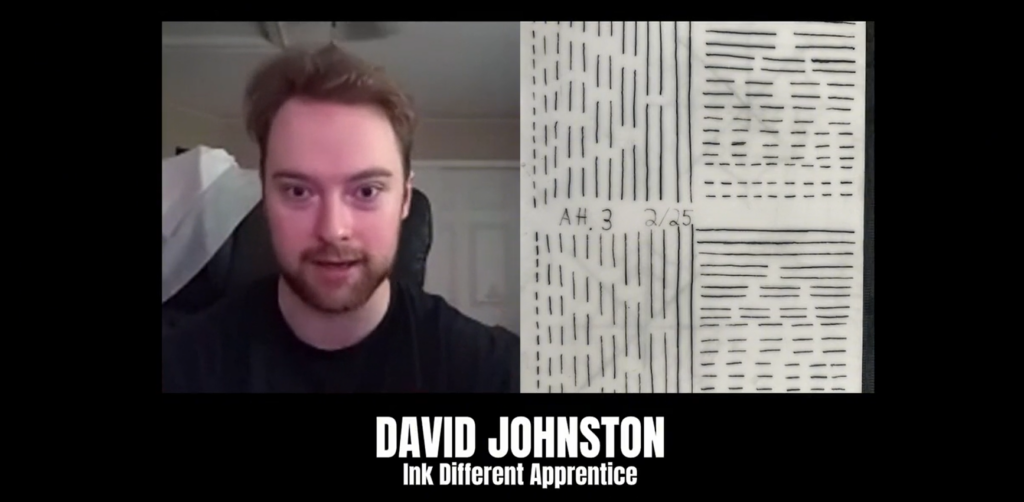
David likes that the curriculum teaches one thing at a time. Line assignments, for example, teach stability, depth control, and how to set your machine’s voltage.
Safety is built into the training, too, including the OSHA bloodborne pathogens standard.
Pro Tip: David found that being fast in Phase One didn’t mean Phase Two would be fast, too. Each phase builds a different skill.
Why Does Depth Matter More Than Speed?
For David, depth was the core challenge. The hard part wasn’t just getting the needle to the right depth. It was maintaining that depth the entire time.
In general, depth affects how cleanly a tattoo heals. Too shallow, and the ink may not hold. Too deep, and lines can blow out and spread under the skin.
David’s progress came from steady practice, not rushing. He even emailed Sarah at Ink Different, worried he wouldn’t finish by his projected date. She reassured him, and he’s kept practicing as much as he can.
How Does Stability Transform a Beginner’s Line Work?
Stability is what keeps a line clean from start to finish, and David built his through repetition.
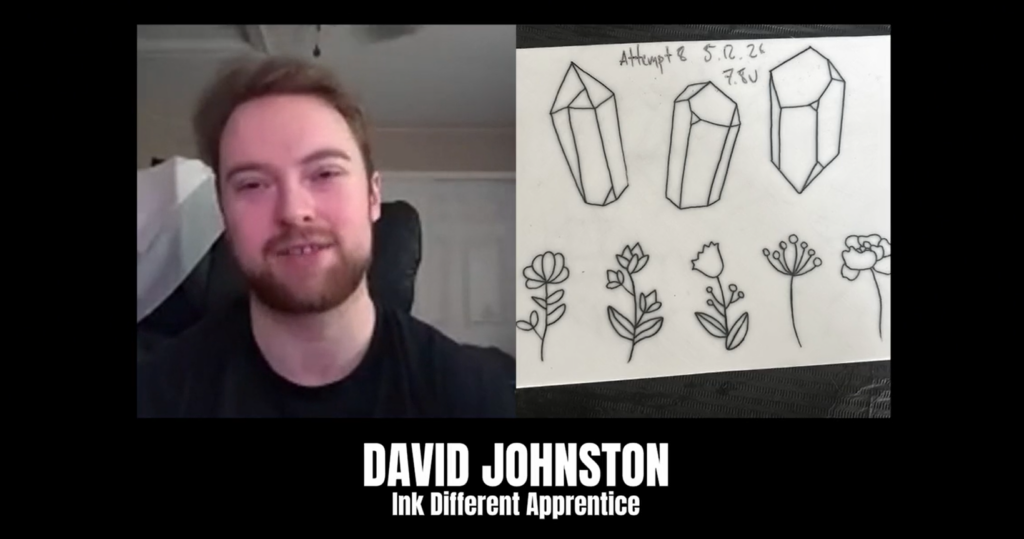
He completed all 30 of his practice pads, front and back. When he compared his very first line assignment to his latest work, he could see how much he’d improved.
Some designs tested his stability more than others:
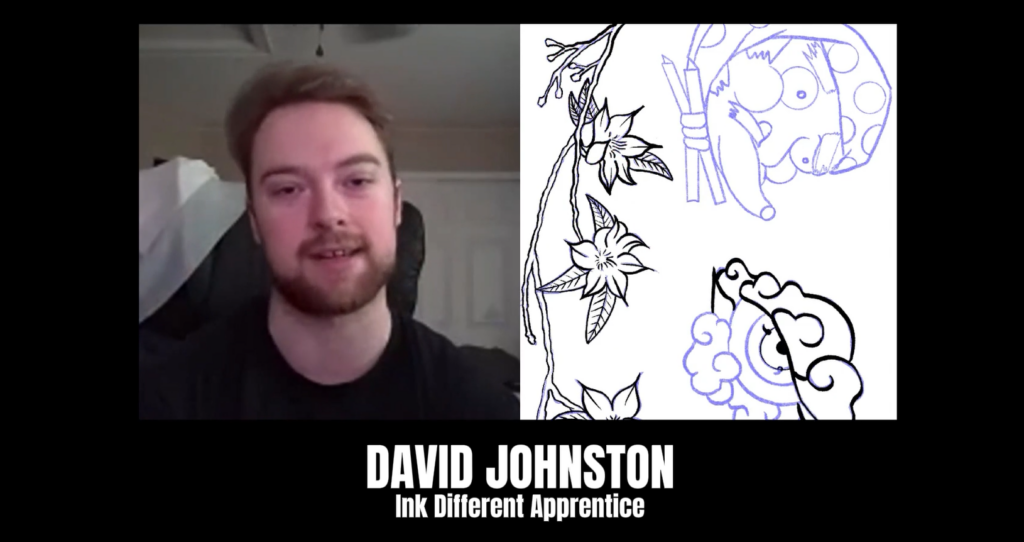
- Tiny florals: Their small, intricate details required precise movement. David says they helped him understand why some Tattoo Artists dislike small tattoos.
- Spider webs: He’s done about 30 attempts.
He also leaned on his Mentors, including Martin, Ruby, and Julian, for blunt, honest feedback. But he knows the effort has to come from him. “They can lead you to the water,” he says, “but you got to be the one to drink it.”
Why “One Line at a Time” Is the Mindset That Wins
For David, thinking in single lines changed how he approaches every tattoo.
With a pencil, he would draw a flower as a complete image, maybe starting with the stem. With a tattoo machine, that doesn’t work. “I need to not think of the pencil as an image,” he says. “I need to think of it as lines that come together instead.”
He also had to plan the order of those lines. He learned to start from the rightmost part of the design and work right to left, so his hand doesn’t smudge the stencil.
That same one-step-at-a-time thinking shapes his mindset. In college, he struggled with comparing his art to others. Now he compares himself only to who he was yesterday. “As long as you’re 1% better tomorrow than you are yesterday, that’s all that counts,” he says.
How Can You Progress Through Phase Two Successfully?
Based on David’s experience:
Step 1: Expect a new learning curve. Even if Phase One goes quickly, the machine is a new skill.
Step 2: Learn one thing at a time. Use line assignments to build stability, depth control, and voltage settings.
Step 3: Think in lines, not images. Break each design into the lines that build it.
Step 4: Plan your starting point. Work from right to left so your hand doesn’t smudge the stencil.
Step 5: Do the reps. David finished all 30 of his practice pads, front and back.
Step 6: Ask for help when you’re worried. David reached out to Sarah when he was concerned about his timeline.
Step 7: Take the feedback, then do the work. His Mentors guided him, but he had to put in the practice.
For gear, see the tools every beginner Tattoo Artist should know.
What Does the Traditional Tattoo Apprenticeship Offer?
Ink Different’s Traditional Tattoo Apprenticeship is an 18 to 24 month, four-phase tattoo apprenticeship that takes beginners to job-ready Tattoo Artists. Ink Different has trained Tattoo Artists for 15 years.
- Phase One: Art and design, online.
- Phase Two: Machine practice on synthetic skin, online. This is where David is now.
- Phase Three: Supervised work in a tattoo studio. David is looking forward to shadowing experienced Tattoo Artists, learning the business and financial side, and building a professional portfolio.
- Phase Four: Building independence and preparing for licensing.
No prior art experience is required. You’ll also get licensing support.
This is a career that comes with confidence. You’ll finish with job-ready skills, licensing support, and a guaranteed job offer at one of Ink Different’s own tattoo studios. The Traditional Tattoo Apprenticeship is available at 60+ tattoo studios nationwide.
What Is the Master Mentorship Program?
Once you’ve built your foundation, Ink Different’s Master Mentorship connects you with Master Mentors, including Al Fliction, Liz Cook, Kyle Dunbar, Boneface, Jordi Pla, Marcel Oliveira, and Kara Gutierrez.
David hopes to specialize in neo-traditional and Japanese styles someday.
Making Tattoo Training Accessible for Everyone
Ink Different offers Spanish-speaking locations in Denver, Orange County, New York City, Miami, San Antonio, and San Diego. Its “Good Humans” culture means you join a supportive community from day one.
Seats are limited, with only two apprentices per tattoo studio per Mentor.
Ready to Become a Tattoo Artist?
David Johnston hit a wall in Phase Two, then worked through it one line at a time. With all 30 of his practice pads done, he’s getting ready for Phase Three.
To David, that process is the point. “Art is about the process of starting from zero and working yourself to a 10,” he says, “and seeing your constant progress.”
Ready to become a Tattoo Artist? Apply now to Ink Different’s Traditional Tattoo Apprenticeship and start building an AI-proof career with licensing support and a guaranteed job offer at one of Ink Different’s own tattoo studios.
Frequently Asked Questions
What happens in Phase Two?
Apprentices learn the tattoo machine and practice on synthetic skin, building stability, depth control, and voltage settings. Phase Two of the Traditional Tattoo Apprenticeship happens online.
Why was Phase Two hard for David?
Maintaining consistent depth and stability with a machine was a new skill, even with his art background. He compares it to “learning how to walk again.”
What were David’s hardest Phase Two assignments?
Tiny florals and spider webs. He’s done about 30 attempts at spider webs.
Do I need prior art experience to start?
No. David has a fine arts degree, but the Traditional Tattoo Apprenticeship is built for beginners.
How long does the Traditional Tattoo Apprenticeship take?
Ink Different’s Traditional Tattoo Apprenticeship takes 18 to 24 months across four phases, with licensing support and a guaranteed job offer at one of Ink Different’s own tattoo studios.
Can I train in Spanish?
Yes. Ink Different offers Spanish-speaking locations in Denver, Orange County, NYC, Miami, San Antonio, and San Diego.
