
Part-Time Tattoo Apprenticeships: Can You Keep Your Day Job?
Yes, many people keep their day job during at least part of a tattoo apprenticeship. It’s easiest when the early stages can be done remotely and at your own pace. Once you move into a tattoo studio for supervised tattooing, you’ll need reliable weekly hours there, so most people plan to shift their schedule as they progress.
A part-time tattoo apprenticeship is training spread across fewer hours per week, so you can keep earning while you learn. This guide covers realistic weekly hours, how people make it work and how state rules can affect your timeline.
Key Takeaways
What is a part-time tattoo apprenticeship?
It’s a tattoo apprenticeship spread across fewer weekly hours, so you can learn the craft while still working another job. You train on a set schedule and practice on your own time.
Structure is what makes it work. A scattered, do-it-yourself approach leaves many beginners stuck. A real tattoo apprenticeship gives you a clear plan, a Mentor and milestones you can hit even while you’re employed elsewhere.

Early training often starts remote, so you can build skills without quitting your day job.
Can you keep your day job during a tattoo apprenticeship?
Often, yes, especially in the early stages. When the first phases are remote, you can build your foundation around your work hours before you ever step into a tattoo studio.
Most people changing careers can’t walk away from their income overnight. A remote start gives you a runway. You keep earning while you learn design principles, build hand control and get comfortable with a tattoo machine.
The schedule changes once you move into the tattoo studio. Supervised tattooing happens around client appointments, which can be hard to fit around a rigid full-time job. That’s why many tattoo apprentices use the remote phases to save money and line up part-time work, flexible shifts or a job with evening or weekend hours.
Honest truth: Part-time is the on-ramp, not the destination. The goal is working as a Tattoo Artist, not keeping tattooing as a permanent side gig.
How does a part-time tattoo apprenticeship work?
It usually starts with fundamentals you can learn around your job, then moves into supervised tattooing at a tattoo studio as your skills grow.
Here’s how Ink Different’s Traditional Tattoo Apprenticeship is set up, as outlined in the full phase breakdown:
Phase 1: Art and Design Principles (remote)
You start with where tattoos come from and how they’re created visually. Then you put those concepts into practice, drawing lines and shading on paper to build hand control. From there, you explore digital work and how tattoos are developed digitally. By the end of Phase 1, you’ll have a portfolio built with both traditional and digital media.
Phase 2: Machine Mastery and Practice Tattooing (remote)
Tattooing is physically demanding, so Phase 2 uses repeated exercises to strengthen your hand control. You learn the basic operation of a professional tattoo machine and practice lining, shading and gradients, and solid color packing. A large portion of this phase moves at your own pace, which is a big help when you’re balancing a job.
Phase 3: Supervised Tattoos (in the tattoo studio)
This is where you move into a tattoo studio and start tattooing real skin under your Mentor’s direct supervision. Before booking an appointment, you submit a tattoo submission form. Your Mentor looks closely at your technical skill, ability to work independently, artistic ability, safety and sanitation knowledge, communication skills and professionalism.
Phase 4: Junior Artist Externship
This is your transition from tattoo apprentice to professional Tattoo Artist. You start earning an income while you refine your skills in a real-world setting, building client relationships and producing quality tattoos.
Safety is part of the training throughout, including the OSHA Bloodborne Pathogens Standard and client aftercare based on the American Academy of Dermatology’s tips for caring for tattooed skin. Before you start, get familiar with these tools every beginner Tattoo Artist should know.
How long does a part-time tattoo apprenticeship take?
Most tattoo apprenticeships take one to three years. Ink Different’s Traditional Tattoo Apprenticeship takes 18 to 24 months. Since much of Phase 2 is self-paced, how much time you put in each week affects how quickly you move forward.
State rules can set the pace too. In Oklahoma, applicants need an approved apprenticeship of 1,500 hours, completed in no less than one year and no more than two years, according to the Oklahoma State Department of Health. Spread over two years, that’s about 15 hours a week. Over one year, it’s about 29 hours a week.
Other states set lower minimums. Arkansas has required at least 375 supervised hours under the Arkansas Code. Many states set no hour minimum at all. Even then, building real skill takes consistent weekly time.
For state-specific details, see how to get your tattoo license in Texas, tattoo license requirements in California and how long it takes to get a tattoo license in Colorado.
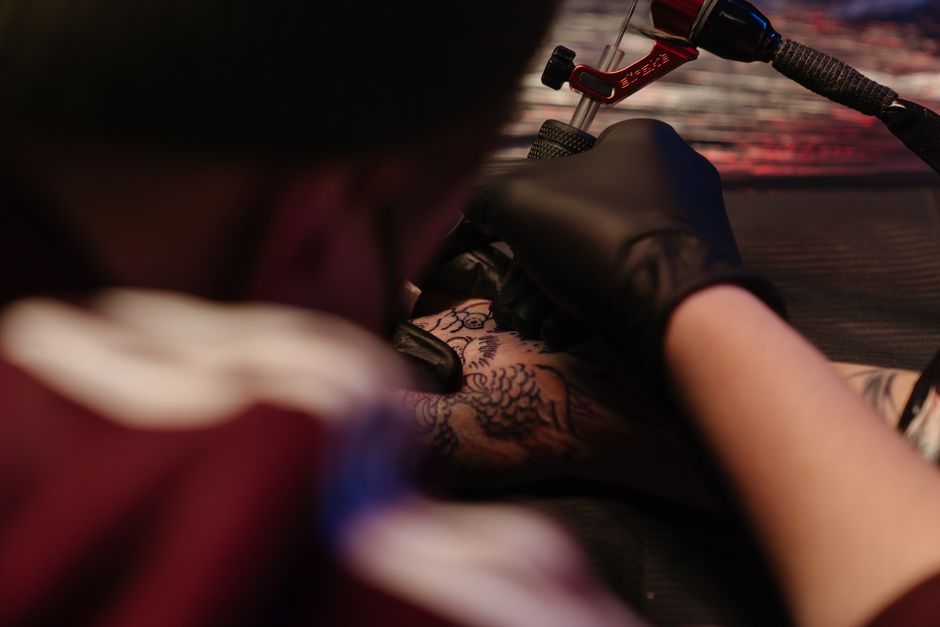
Live, in-person mentorship is where part-time training turns into real-world skill.
How do you balance a full-time job with tattoo training?
Protect consistent weekly training blocks, practice portable skills whenever you can and plan ahead for the move into the tattoo studio.
Here’s what a realistic week might look like:
- During Phases 1 and 2 (remote): Set training sessions around your work hours, plus five to 10 hours of drawing and hand-control practice.
- During Phase 3 (in the tattoo studio): Supervised appointments with your Mentor, often including evenings or weekends, plus ongoing practice.
- During Phase 4: More time tattooing clients as you start earning and building your client base.
Habits that help:
- Block your time: Treat training like an appointment you’d never cancel.
- Practice anywhere: Sketch on lunch breaks or commutes.
- Use the remote phases to prepare: Build savings and line up flexible work before Phase 3.
- Plan with your Mentor: Map out your tattoo studio days in advance.
- Avoid common traps: Read about the mistakes aspiring tattoo apprentices should avoid.
- Build your name early: Use these platforms to help new and aspiring Tattoo Artists build their brand.
How to start a part-time tattoo apprenticeship (step by step)
Map your real availability, work through your remote phases, then plan your schedule for the move into the tattoo studio.
- Step 1: Get honest about your time. Figure out how many hours you can commit each week without burning out.
- Step 2: Check your state’s rules. Find out whether your state requires minimum hours, apprentice registration or a set timeline.
- Step 3: Choose structured training. Look for a remote start, in-person mentorship and licensing support.
- Step 4: Build your foundation remotely. Work through design principles, hand control and machine practice.
- Step 5: Prepare for the tattoo studio. Before Phase 3, build savings and adjust your work schedule.
- Step 6: Plan your transition. As you reach Phase 4 and start earning, map out when you’ll leave your day job.
If you’re leaving another field, read why a tattoo apprenticeship is perfect for career changers starting over.
Why train with Ink Different Tattoos?
Ink Different Tattoos has trained professional Tattoo Artists for 15 years. Training starts remotely, then continues in person with experienced Mentors.
What you can expect from our Traditional Tattoo Apprenticeship
The Traditional Tattoo Apprenticeship runs 18 to 24 months across four phases. You complete Phases 1 and 2 remotely, then move into one of 60+ tattoo studios nationwide in Phase 3 for supervised tattooing with a Mentor. It’s built for beginners, so no prior experience is required. Interest-free payment plans help make training more manageable while you’re still working.
A career that comes with confidence
You’ll finish with job-ready skills, licensing support and a guaranteed job offer at one of Ink Different’s own tattoo studios. Tattooing is also hard to automate. Read why Tattoo Artists are still essential. And it can pay well. According to ZipRecruiter, the average Tattoo Artist in the United States earns $106,858 a year as of November 2026.
Mentorship that pushes your brand and skills further
Our one-year, in-person Master Mentorship lets you train alongside celebrity and award-winning Master Mentors, including Al Fliction, Liz Cook, Kyle Dunbar, Boneface, Jordi Pla and Marcel Oliveira. It’s built for mastering a style, growing your career and owning your own business.
Making tattoo training accessible for everyone
We offer Spanish-speaking locations in Denver, Orange County, NYC, Miami, San Antonio and San Diego. Learn why tattoo apprenticeships are gaining ground as a solid alternative to college.
A note on seats: Each Mentor takes just two tattoo apprentices per tattoo studio, so seats fill up quickly.
Ready to become a Tattoo Artist?
A remote start means you don’t have to give up your paycheck on day one. Phase 2 moves at your own pace, and Phase 4 lets you start earning as a Tattoo Artist. With a plan for your hours and savings, you can work toward a tattoo career at a pace that fits your life.
Ready to become a Tattoo Artist? Apply now to Ink Different’s Traditional Tattoo Apprenticeship and start building an AI-proof career with licensing support along the way.
Frequently Asked Questions
Can I do a tattoo apprenticeship while working full-time?
Often, at least at first. Ink Different’s Traditional Tattoo Apprenticeship starts remotely, and much of Phase 2 is self-paced. Once training moves into the tattoo studio in Phase 3, many people switch to part-time or flexible work.
Does Ink Different’s Traditional Tattoo Apprenticeship start remotely?
Yes. Phase 1 (Art and Design Principles) and Phase 2 (Machine Mastery and Practice Tattooing) are remote. In Phase 3, you move into a tattoo studio for supervised tattooing with your Mentor.
When do I start tattooing real skin?
In Phase 3. You submit a tattoo submission form before booking, then tattoo under your Mentor’s direct supervision.
Can I earn money during the Traditional Tattoo Apprenticeship?
Yes, in Phase 4. The Junior Artist Externship lets you start earning an income while you keep refining your skills.
How many hours a week is a part-time tattoo apprenticeship?
It varies. Plan for regular training time plus five to 10 hours of practice. In Oklahoma, the required 1,500 hours over one to two years works out to roughly 15 to 29 hours a week.
How long does the Traditional Tattoo Apprenticeship take?
It runs 18 to 24 months across four phases.
