
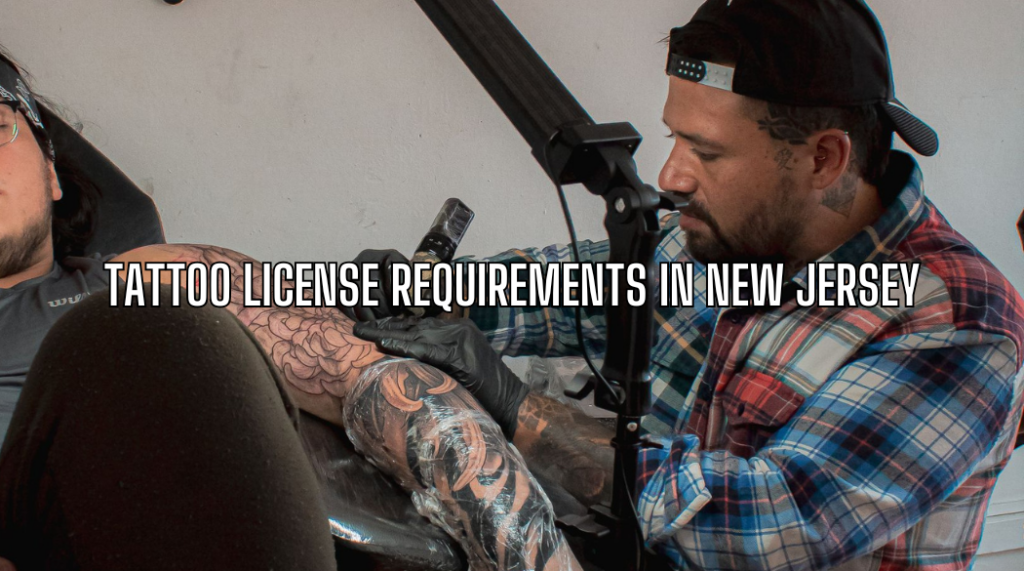
Tattoo License Requirements in New Jersey
Key Takeaways
How does New Jersey regulate tattooing?
New Jersey regulates tattooing through local health departments, which license body art establishments and enforce the state rules in N.J.A.C. 8:27, rather than the state issuing individual artist licenses.
The New Jersey Department of Health (NJDOH) maintains the body art standards in N.J.A.C. 8:27, titled Body Art and Ear-Piercing Facility Standards. Subchapter 7 covers tattooing, and other subchapters cover administration, sanitation, bloodborne pathogen safety, and record keeping. The county or municipal health authority where the tattoo studio operates applies those rules. This is a county-local model.
Because the state sets the standards and local departments apply them, the exact paperwork and establishment fees can vary from town to town. Always confirm details with the health department that covers the studio where you plan to work. NJDOH explains the framework on its body art page.
What does this mean for you as an aspiring Tattoo Artist?
It means you build your qualification through supervised hours and documented work rather than by passing a state exam or paying a state license fee.
There is no statewide test you sit for and no individual artist license number you apply for at the state level. Instead, your records show that you completed the required apprenticeship, and the establishment and local health authority review them. Your classification as an apprentice or practitioner follows from those records.
That makes real training the center of your path. The studio you work in must hold a valid local license, and you work within its walls under the rules your local department enforces. Your focus should be on accumulating quality hours, mastering safety, and producing records that stand up to review.
Tip: Choose a tattoo studio that already holds a current local license and has a Mentor willing to supervise your hours. That environment is what the county or municipal authority recognizes.
What is the difference between a Practitioner and an Apprentice?
New Jersey uses a two-tier classification: an apprentice works under direct supervision, while a practitioner has completed a 2,000-hour apprenticeship and documented their work.
Under the state rules, an apprentice performs tattooing under the direct supervision of a practitioner in order to learn. A completed apprenticeship means at least 2,000 hours at a tattooing establishment under that direct supervision. Once you have completed it and documented your work, you can qualify as a practitioner. The local health authority makes the final call.
This structure rewards time spent doing the work beside an experienced Mentor. The hours are how you learn safe technique, client communication, and the day-to-day discipline of a professional Tattoo Artist.
The state rules do not set a minimum age in the sections covering practitioners and apprentices. If age matters for your situation, confirm it directly with your local health authority, since local policy can add requirements.
How do you get licensed to tattoo in New Jersey step by step?
You complete bloodborne pathogens training, log 2,000 hours under supervision, assemble your records and portfolio, and submit them for review through the studio and your local health department.
- Complete OSHA-compliant bloodborne pathogens training. Practitioners must show evidence of a current bloodborne pathogens course, so finish it early and keep it current.
- Find a licensed tattoo studio and a Mentor. Begin as an apprentice under direct supervision inside an establishment that holds a current local license.
- Log your hours. Work toward the 2,000 hours required for a completed apprenticeship. Keep accurate records of your time.
- Build your portfolio. Prepare at least 10 client applications and photographs of tattoos you personally performed, along with consent forms or testimonials from three clients.
- Submit your records. The establishment operator keeps your qualification records, and your local health department reviews them. Some counties use a new-hire application, so confirm the exact process with yours.
New Jersey does not require a state exam for tattooing.
What Records Do You Need to Submit?
Requirements are set by N.J.A.C. 8:27-7.1 and applied locally. Expect to provide:
- Apprenticeship records: Documentation that you completed at least 2,000 hours under direct supervision.
- Client applications: At least 10, for tattoos you personally performed, each with the client’s identifying details and proof of age.
- Photographs: Photos or digital images of those tattoos, with adverse reaction reports if applicable.
- Client consent forms or testimonials: From three clients.
- Bloodborne pathogens evidence: Proof of a current course.
- Insurance, where required: Some counties, such as Gloucester County, ask for professional liability insurance for new hires and apprentices.
What does a tattoo license in New Jersey cost?
There is no state license fee for individual tattoo artists in New Jersey. The local health authority licenses the body art establishment and sets its own fees.
Because the state does not charge individual artists, your out-of-pocket licensing cost depends on where the studio operates. The county or municipal department that licenses the establishment sets those fees, and they differ by location.
There is also no individual state license to renew. Instead, the establishment’s local license must be renewed on the schedule its local authority sets. If you own or manage a studio, that renewal is on your radar. If you are an artist working inside a licensed studio, the renewal responsibility falls to the establishment.
For the exact fee schedule in your area, contact the local health department directly and review the official resources at the end of this guide.
Can you transfer a tattoo license from another state?
No, New Jersey does not offer license transfer or reciprocity for tattoo artists moving from another state, but documented experience can still count toward your qualification.
If you are relocating, plan to meet New Jersey’s standards directly. That means completing OSHA-compliant bloodborne pathogens training, working within a locally licensed establishment, and documenting your qualifications under N.J.A.C. 8:27-7.
Using Out-of-State Experience
The rule allows documentation of training that is at least equivalent to the 2,000-hour apprenticeship, so experienced artists from other states often have records to work with. Your local health department decides what it accepts. Gather proof of your hours, your client applications, and photographs of your work before you apply, and verify how your department wants out-of-state experience documented.
What mistakes should you avoid?
The most common mistakes are assuming the state issues individual licenses, skipping bloodborne pathogens training, and working in a studio that lacks a current local license.
- Waiting for a state license that does not exist. New Jersey licenses the establishment, so focus on your hours and your records.
- Treating bloodborne pathogens training as optional. Practitioners must show evidence of a current course.
- Working in an unlicensed studio. Your hours and classification depend on working inside an establishment that holds a valid local license.
- Assuming reciprocity. An out-of-state credential will not carry over, though documented equivalent experience can help.
- Keeping sloppy records. Missing hour logs, client applications, or photographs can stall your qualification. Beginners who rush also run into avoidable early mistakes.
- Guessing at local fees or rules. Fees and procedures are set locally, so always confirm with the health authority that covers your studio.
Warning: Never assume one town’s process matches another’s. Because New Jersey uses a county-local model, the department that licenses your studio has the final say.
Learning to tattoo with Ink Different
Ink Different is a serious alternative to a four-year degree, training you through the structured Traditional Tattoo Apprenticeship so you build the supervised experience, portfolio, and safety knowledge New Jersey expects.
Tattooing is an AI-proof career built on human skill, trust, and craft, which is why skilled Tattoo Artists keep their value. A professional Tattoo Artist can earn over $106,000 a year, according to ZipRecruiter, and the path there runs through real mentorship and real repetition.
The Traditional Tattoo Apprenticeship pairs you with a Mentor and runs 18 to 24 months across four phases, from Art and Design Principles through Machine Mastery and Practice Tattooing and Supervised Tattoos to a Junior Artist Externship where apprentices start earning an income. Each phase is laid out in more detail on the apprenticeship overview. You learn on a tattoo machine the right way, start with the basic tools of the trade, build your portfolio, and understand OSHA-compliant bloodborne pathogens safety from day one. How training hours count toward New Jersey’s 2,000-hour standard is decided by your local health department, so confirm it early. We provide licensing support so you understand how your hours and portfolio fit New Jersey’s local requirements. You graduate with job-ready skills, licensing support, and a guaranteed job offer at one of Ink Different’s own tattoo studios.
The Traditional Tattoo Apprenticeship is available at 60+ tattoo studios nationwide, each led by one of our chosen Mentors, including Spanish-speaking locations near Denver, Orange County, New York City, Miami, San Antonio, and San Diego. Seats are limited, with only two apprentices per tattoo studio per Mentor.
Ready to become a Tattoo Artist? Apply now to Ink Different’s Traditional Tattoo Apprenticeship and start building an AI-proof career, with licensing support along the way.
Frequently Asked Questions
Does New Jersey issue an individual tattoo license?
No. New Jersey local health departments license body art establishments and approve the people who work in them. The state health department sets the standards under N.J.A.C. 8:27 but does not issue individual tattoo licenses.
How many hours do you need to become a Practitioner in New Jersey?
You need a completed apprenticeship of at least 2,000 hours under direct supervision to qualify as a practitioner. With less, you are an apprentice who must work under direct supervision, as described in N.J.A.C. 8:27-7.
Is there a state exam to tattoo in New Jersey?
No. New Jersey does not require a state exam for tattooing.
How much does a tattoo license cost in New Jersey?
There is no state license fee for individual artists. The local health authority licenses the body art establishment and sets its own fees, which vary by location.
Can I transfer my tattoo license from another state to New Jersey?
No. New Jersey does not offer reciprocity. You must meet New Jersey’s requirements directly, though documentation of training at least equivalent to the 2,000-hour apprenticeship can help. Your local health department decides what it accepts.
Do I have to renew my tattoo license every year?
There is no individual state license to renew. The establishment’s local license is renewed on the schedule its local health authority sets.
