
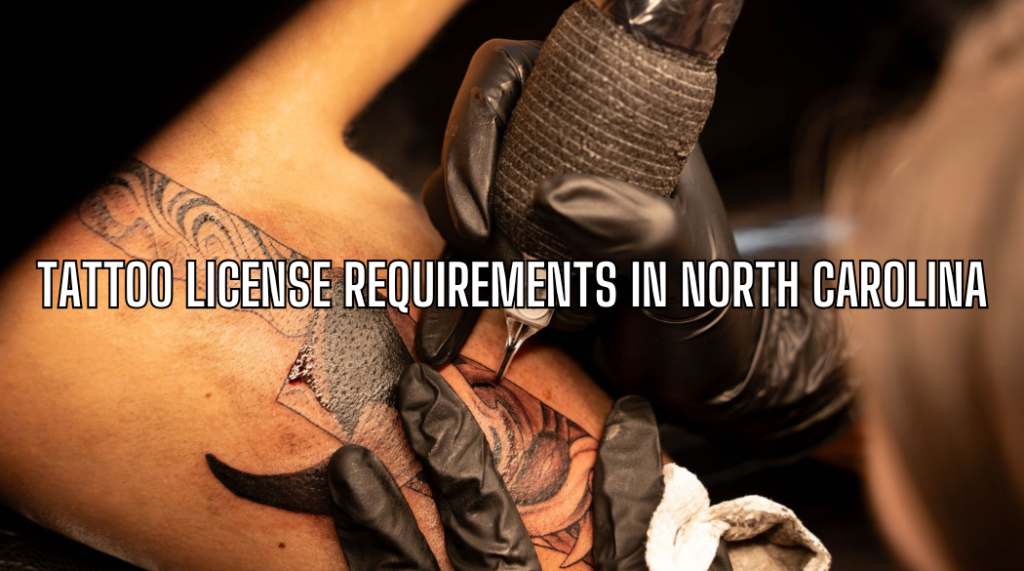

Tattoo License Requirements in North Carolina
Key Takeaways
How does North Carolina regulate tattooing?
North Carolina regulates tattooing through a county-local model, where the state sets the rules and each local health department issues the permit after inspecting the tattoo establishment.
The governing statute is N.C. Gen. Stat. § 130A-283, and the detailed tattooing rules live at 15A NCAC 18A .3200. The permitting procedure is spelled out in 15A NCAC 18A .3202. You can also read the full set of state tattooing rules.
This means there is no single statewide tattoo license you apply for once and carry everywhere. Your permit is issued in your name, lists the address of the establishment where you will practice, and is granted only after an inspection confirms the rules are being met. It must be posted where the public can see it.
North Carolina tattoo license at a glance
- Regulator: NCDHHS sets the rules, and local health departments issue permits.
- Governing law: N.C. Gen. Stat. § 130A-283, with rules at 15A NCAC 18A .3200 and .3202.
- Licensing model: County-local. The permit is issued to an individual artist and lists the establishment where they practice.
- Fee example: $500 per year in Guilford County. Fees are set by each local board of health.
- Exam: No written state exam. An inspection must verify compliance before the permit is issued.
- Timing: Apply at least 30 days before you start tattooing, and renew at least 30 days before expiration.
What are the tattoo license requirements in North Carolina?
To tattoo legally in North Carolina, you need a tattooing permit from your local health department, issued after an inspection and tied to the establishment where you will work.
Here is what the county expects:
- Tattooing permit: A permit from the local health department, issued in your name and listing your establishment’s address.
- Inspection: The health department must verify compliance with the state tattooing rules before it issues the permit.
- Application details: Your name and mailing address, the name and street address of the establishment, your anticipated start date, and your signature.
- Fee: Set by the local board of health. Guilford County, for example, charges $500 a year and includes permanent makeup artists.
- No required hours: State rules set no training or apprenticeship hour requirement.
No required hours does not mean skill is optional. The inspection has to confirm safe, sanitary practices, and no reputable tattoo studio hires an untrained artist.
What About Bloodborne Pathogens Training?
The state’s permit rules do not currently list bloodborne pathogens (BBP) training as an application requirement, but it is standard practice and increasingly expected. Some counties strongly encourage a current BBP certificate, and Orange County’s Environmental Health office offers an annual class for tattoo artists. Legislation introduced in 2025 would require annual BBP training for tattooing permits, so check the current status with your county. Either way, hold a current certificate that meets the OSHA bloodborne pathogens standard.
Age Rules
North Carolina law makes it unlawful to tattoo anyone under 18 (G.S. 14-400). Complying with the permit rules does not protect an artist from prosecution under that law.
Tip: Because fees and application details vary by county, confirm requirements directly with the health department in the county where you plan to work before you apply.

How do you get a tattoo license in North Carolina step by step?
You get a North Carolina tattooing permit by training to a professional standard, securing a spot at a tattoo establishment, applying to your county health department, and passing the inspection.
- Learn to tattoo properly. Even though the state sets no required hours, you need real skill in sterile technique, machine handling, and safe practice. A structured tattoo apprenticeship with an experienced Mentor is the proven route.
- Get safety training. Complete bloodborne pathogens training and keep your certificate current, even where it is not formally required.
- Line up a specific establishment. Because the permit lists the establishment where you will practice, you need a confirmed working location before you apply.
- Apply early. Submit your application and the county fee to your local health department at least 30 days before you plan to start tattooing.
- Pass the inspection. The department inspects the establishment and verifies compliance with the tattooing rules.
- Receive and post your permit. Once issued, it is valid for one year for that artist and establishment, and it must be posted where visitors can easily see it.
You can review the permitting rule at 15A NCAC 18A .3202 and the broader rules at 15A NCAC 18A .3200.
How much does a North Carolina tattoo permit cost?
Tattoo permit fees in North Carolina are set by each county’s local board of health, and Guilford County charges $500 a year for a tattoo artist permit.
Because the model is county-local, there is no single statewide fee. Guilford County’s $500 annual amount is a published example, but your county may charge a different figure. The permit is renewed annually, so budget for it every year.
Renewal applications are due at least 30 days before your permit expires. Mark your calendar well ahead of the expiration date so you do not lose the ability to work legally. Confirm the exact fee for your own county with its health department.
Warning: Do not assume every county matches Guilford’s $500. Always verify your county’s fee before you plan your budget.
What if you are moving to North Carolina from another state?
North Carolina permits are issued by counties and cannot be transferred, so moving here means applying for a new permit in the county where you will work.
If you already tattoo in another state, your home-state credential does not replace a North Carolina permit. You still need a permit from the local health department, listing the specific establishment where you will work. If you are visiting for a short guest spot, ask the county whether it offers a temporary permit.
The same rule applies if you relocate within North Carolina. Because the permit lists one artist and one location, and cannot be transferred to another person or place, changing shops or counties requires a new application and inspection. Apply at least 30 days before you plan to start.
What mistakes should you avoid?
The biggest mistakes are assuming the permit is portable, skipping real training because no hours are required, and missing the 30-day application and renewal windows.
- Treating the permit as portable. It lists one artist and one establishment. Change either and you need a new permit.
- Skipping serious training. No statewide hour requirement does not mean you can skip learning. Inspectors look for safe, sanitary practice, and clients trust skilled hands.
- Missing deadlines. Applications and renewals are due at least 30 days before you start or before expiration. A lapsed permit means you cannot legally tattoo.
- Guessing at county fees. Guilford’s $500 is one example, not a universal number. Confirm with your county.
- Applying without a confirmed establishment. Since the permit lists the specific location, you need that location locked in first.
- Overlooking safety training. Even where bloodborne pathogens training is not yet mandated, a current certificate protects your clients and your reputation.
Learning to tattoo with Ink Different
Ink Different Tattoos is a serious alternative to a four-year degree, training you to the professional standard North Carolina inspectors and tattoo studios expect.
Because North Carolina sets no required training hours, the quality of your education is up to you and your Mentor. That is both a risk and an opportunity. The artists who thrive are the ones who learn sterile technique, strong fundamentals, and real studio craft from day one.
Our Traditional Tattoo Apprenticeship pairs you with an experienced Mentor and builds the skills that let you pass a county inspection with confidence. It runs 18 to 24 months across four phases, from Art and Design Principles through Machine Mastery and Practice Tattooing and Supervised Tattoos to a Junior Artist Externship where apprentices start earning an income. Each phase is laid out in more detail on the apprenticeship overview. You start with the basic tools of the trade and build from there.
Tattooing is an AI-proof craft done by human hands, which is why skilled human Tattoo Artists stay in demand. A professional Tattoo Artist can earn over $106,000 a year, according to ZipRecruiter. You graduate with job-ready skills, licensing support so you understand exactly what your county requires, and a guaranteed job offer at one of Ink Different’s own tattoo studios.
The Traditional Tattoo Apprenticeship is available at 60+ tattoo studios nationwide, each led by one of our chosen Mentors, including Spanish-speaking locations near Denver, Orange County, New York City, Miami, San Antonio, and San Diego. Seats are limited, with only two apprentices per tattoo studio per Mentor.
Ready to become a Tattoo Artist? Apply now to Ink Different’s Traditional Tattoo Apprenticeship and start building an AI-proof career, with licensing support along the way.
Frequently Asked Questions
Do you need a license to tattoo in North Carolina?
Yes. You need a tattooing permit issued by your county health department, in your name and listing the establishment where you will practice, under N.C. Gen. Stat. § 130A-283.
Is there a state tattoo exam in North Carolina?
No. There is no written state exam. The health department must inspect and verify compliance with the state tattooing rules before it issues a permit.
How much does a tattoo permit cost in North Carolina?
Fees are set by each county’s local board of health. Guilford County charges $500 a year for a tattoo artist permit, and other counties may differ.
How long is a North Carolina tattoo permit valid?
A permit is valid for one year and issued for one artist at one establishment. Renewal applications are due at least 30 days before expiration.
Does North Carolina require a tattoo apprenticeship?
No. State rules at 15A NCAC 18A .3200 set no training or apprenticeship hour requirement, but a tattoo apprenticeship is the proven way to learn safe, professional skills.
Can I transfer my permit if I move to another shop or county?
No. The permit cannot be transferred to another person or place of practice. Moving shops or counties requires a new permit and a new inspection.
