
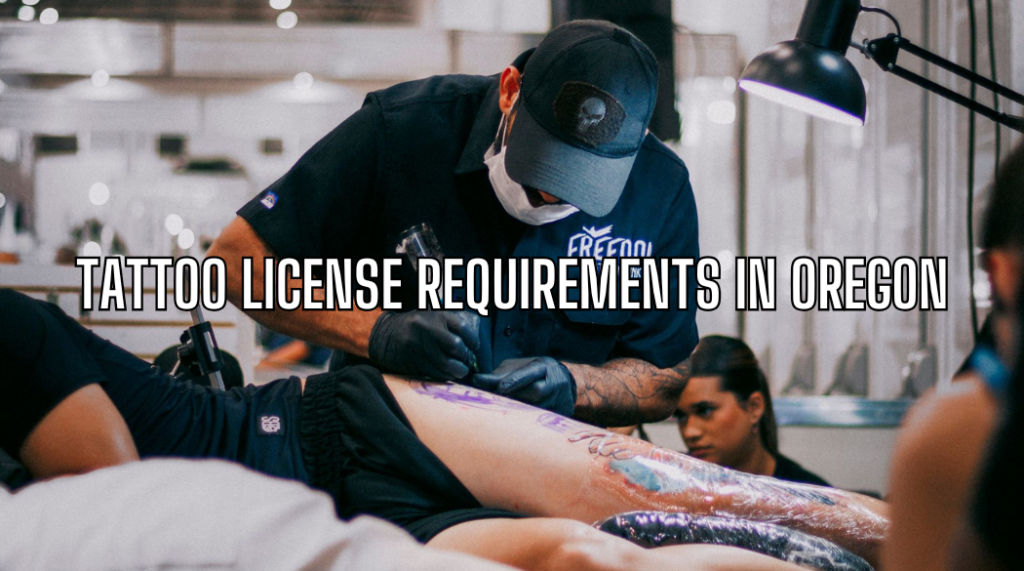
Tattoo License Requirements in Oregon
Key Takeaways
How does Oregon regulate tattooing?
Oregon regulates tattooing through the Health Licensing Office (HLO) and its Board of Body Art Practitioners, which issues a state-level tattoo license under ORS chapter 690 and the rules in OAR chapter 331, division 915. One credential from one state agency covers you to work anywhere in Oregon, rather than a patchwork of city or county permits.
What sets Oregon apart is its formal education requirement. Instead of asking you to log supervised hours in a shop, Oregon requires an approved 360-hour curriculum before you can test. Under OAR 331-915-0005, the course includes at least 210 hours of theory and 150 hours of practical tattooing experience, taught by an Oregon licensed tattoo artist registered as a teacher by the Higher Education Coordinating Commission.
The HLO sets the curriculum standards, administers the written exam, and tracks renewals. The HLO tattoo artist license page is the official starting point for every rule.
Oregon tattoo license at a glance
The tattoo license in Oregon is a one-year, state-issued credential administered by the Health Licensing Office. Here are the core facts before we get into detail.
- Regulator: Health Licensing Office (HLO), Board of Body Art Practitioners.
- Governing law: ORS chapter 690 and OAR chapter 331, division 915.
- Licensing model: State license, one credential statewide.
- Minimum age: 18, with a high school diploma or equivalent.
- Education: An approved 360-hour tattoo curriculum.
- Exam: HLO written exam, 100 multiple-choice questions, 75 percent to pass.
- Fees: $50 application, $50 written exam, $50 license.
- Validity: One year, renewable for $50, or $45 online.
You can verify each amount in the HLO’s fee rule, OAR 331-940-0000, before you budget.
What does Oregon’s model mean for you?
Oregon’s model means your route to a tattoo license runs through an approved 360-hour curriculum rather than open-ended shop hours, so your education is front-loaded and structured. That changes how you plan your career from the start.
In many states you can learn almost entirely on the job through a tattoo apprenticeship with a Mentor. In Oregon, the HLO expects you to complete the 360-hour curriculum at an approved career school, and the school sends your official transcript directly to the HLO, before you hold a license. The upside is clarity. You know exactly what the state wants, and the credential is tied to a measurable standard.
It also means the quality of your training shapes your whole career. The hours are the foundation, and a program that prepares you well for the written exam will serve you better than one that meets the minimum. For a sense of how other states handle licensing, see our guide to tattoo license requirements in California.
What are the requirements for a tattoo license in Oregon?
To earn a tattoo license in Oregon, you must be at least 18, hold a high school diploma or equivalent, complete the approved 360-hour curriculum, show current CPR, first aid, and bloodborne pathogens training, and pass the HLO written exam. These requirements come from OAR 331-915-0015.
Here is how the requirements break down:
- Age and education: Proof that you are 18 or older and have a high school diploma or equivalent.
- Tattoo education: An official transcript from an approved tattooing career school, sent directly to the HLO, showing completion of the required curriculum.
- Bloodborne pathogens: Documentation of bloodborne pathogens training from an HLO-approved provider. See the OSHA bloodborne pathogens standard and our guide to bloodborne pathogens certification for Tattoo Artists.
- CPR and first aid: Documentation of CPR and basic first aid training from an HLO-approved provider. The courses must be hands-on, or blended with a hands-on skills assessment.
- Exam: A passing score on the HLO written exam within two years of your application date.
- Identification: Two forms of identification, one with a photo, with matching legal names.
The Written Exam
The written exam has 100 multiple-choice questions, a 100-minute time limit, and a 75 percent passing score. After you pass and pay all fees, you receive your Oregon license the same day. If you fail, you wait before retaking it, according to the HLO’s retake policy.
Tip: Line up your CPR, first aid, and bloodborne pathogens training early. The HLO wants them current at application and again at every renewal.
How do you get your tattoo license in Oregon step by step?
You get a tattoo license in Oregon by completing the approved 360-hour curriculum, gathering your documents and certifications, passing the HLO written exam, and paying the application, exam, and license fees.
- Confirm you meet the basics. You must be 18 or older and hold a high school diploma or equivalent.
- Enroll in an approved program. Choose a program that delivers the required 360-hour curriculum and prepares you for the HLO written exam.
- Complete your safety training. Finish CPR, first aid, and bloodborne pathogens training through approved providers and keep the certificates.
- Graduate and have your transcript sent. Your approved career school sends your official transcript directly to the HLO.
- Apply to the HLO. Submit the application and the $50 application fee.
- Pass the written exam. Pay the $50 examination fee and take the exam within two years of your application date.
- Pay the license fee. After you pass, pay the $50 license fee to receive your license.
Confirm every current amount in OAR 331-940-0000. If you are weighing where to train in the Pacific Northwest, our Kitsap County tattoo apprenticeship page shows what training looks like nearby.
How much does a tattoo license in Oregon cost?
A new tattoo license in Oregon costs $50 for the application, $50 for the written exam, and $50 for the license, and renewal is $50, or $45 if you renew online. These fees are set in OAR 331-940-0000.
Here is the fee breakdown for budgeting:
- Application fee: $50.
- Written exam fee: $50.
- License fee: $50.
- Reciprocity application fee: $150, plus a $50 license fee when you qualify.
- Annual renewal: $50 by mail or in person, or $45 online.
- Delinquency fee: $50 per year, up to three years.
These figures are the state charges only. Your biggest investment is the training that gets you through the 360-hour curriculum and the exam, plus your CPR, first aid, and bloodborne pathogens courses.
What if you are moving to Oregon from another state?
If you hold an active tattoo license from another state, you can apply through the HLO’s reciprocity pathway, which has a $150 application fee and still requires you to pass the written exam.
Under OAR 331-915-0015, you submit an affidavit of licensure showing a current license with no active or pending discipline, pass the HLO written exam within two years of your application, and pay the license fee. The HLO looks at whether your home state’s requirements are substantially equivalent to Oregon’s. If they are not, the HLO page explains that you may be able to demonstrate your work experience as a tattoo artist to its satisfaction.
The practical move is to contact the HLO before you relocate and ask about your records. Do not assume your current license transfers automatically. Review the HLO tattoo artist license page for the current process.
What mistakes should you avoid?
The most common Oregon mistakes are underestimating the 360-hour curriculum requirement, letting CPR or bloodborne pathogens training lapse, and assuming an out-of-state license transfers without review.
- Treating the 360 hours as a formality. They are the backbone of the Oregon model and cannot be skipped.
- Expired certifications. Current CPR, first aid, and bloodborne pathogens training are conditions of renewal every year, and they do not count toward continuing education hours.
- Missing continuing education. You must complete 10 hours every year under OAR 331-915-0055, and keep your records for five years.
- Missing the annual renewal. A license can stay inactive for up to three years with delinquency fees, and after that you must reapply and meet the original requirements under OAR 331-915-0050.
- Assuming reciprocity is automatic. You still pass the written exam and pay the application and license fees.
- Choosing training that ignores Oregon’s standard. Pick a program built around real hours and real craft, and confirm with the HLO that it counts. Beginners who rush also run into avoidable early mistakes.
Learning to tattoo with Ink Different
Ink Different is a serious alternative to a four-year degree, and the Traditional Tattoo Apprenticeship is built around hands-on, Mentor-led craft and the safety discipline Oregon expects.
Oregon’s licensing pathway runs through an approved career school and a transcript sent to the HLO, so confirm with the HLO how any training counts toward your license before you enroll. What a Mentor-led apprenticeship adds is the day-to-day craft: machine control, line work, sanitation habits, and client care. Those skills carry into the HLO written exam and into your first years in the chair.
The Traditional Tattoo Apprenticeship runs 18 to 24 months across four phases, from Art and Design Principles through Machine Mastery and Practice Tattooing and Supervised Tattoos to a Junior Artist Externship. You can see the early work in apprentice Alex McLean’s account of relearning how to draw for tattooing in Phase One. We also provide licensing support, so the paperwork never becomes the thing that holds you back.
You graduate with job-ready skills, licensing support, and a guaranteed job offer at one of Ink Different’s own tattoo studios. The Traditional Tattoo Apprenticeship is available at 60+ tattoo studios nationwide, each led by one of our chosen Mentors, including Spanish-speaking locations near Denver, Orange County, New York City, Miami, San Antonio, and San Diego. Seats are limited, with only two apprentices per tattoo studio per Mentor.
Ready to become a Tattoo Artist? Apply now to Ink Different’s Traditional Tattoo Apprenticeship and build job-ready skills, with licensing support along the way.
Frequently Asked Questions
Who issues a tattoo license in Oregon?
The Oregon Health Licensing Office, through its Board of Body Art Practitioners, issues every tattoo license in Oregon under ORS chapter 690.
How many hours of training do you need for an Oregon tattoo license?
Oregon requires an approved 360-hour curriculum with at least 210 hours of theory and 150 hours of practical tattooing, under OAR 331-915-0005.
How much does a tattoo license cost in Oregon?
Expect a $50 application fee, a $50 written exam fee, and a $50 license fee. Reciprocity applicants pay a $150 application fee and a $50 license fee, under OAR 331-940-0000.
How long is an Oregon tattoo license valid?
The license is valid for one year. Renewal costs $50, or $45 online, and requires current CPR, first aid, and bloodborne pathogens training plus 10 hours of continuing education.
Can I transfer my out-of-state tattoo license to Oregon?
Oregon offers a reciprocity pathway for active licenses with no pending discipline. You submit an affidavit of licensure, pay the $150 application fee, pass the written exam, and pay the license fee. Confirm the details with the HLO.
What age do you have to be to get a tattoo license in Oregon?
You must be at least 18 years old and have a high school diploma or equivalent, under OAR 331-915-0015.
Sources (checked November 20, 2026)
- Board of Body Art Practitioners, Tattoo Artists License (Oregon Health Licensing Office)
- OAR 331-915-0015, Application Requirements for Tattoo License
- OAR 331-915-0005, Tattoo Education
- OAR 331-915-0050, Renewal of a Tattoo License
- OAR 331-915-0055, Continuing Education for Tattoo License
- OAR 331-940-0000, Board of Body Art Fees
- ORS Chapter 690 (Oregon Legislature)
- OSHA Bloodborne Pathogens Standard
